

SK hynix, the Korean memory-chip maker, is listing American Depositary Shares (ADSs) on the Nasdaq Global Select Market under the ticker SKHY. Per its SEC final prospectus dated July 9, 2026, the company is offering 177,900,000 ADSs at US$149.00 each — a roughly US$26.5 billion offering, one of the year’s largest U.S. market debuts. Its shares already trade in Korea, so this is a U.S. listing of an existing public company, not a startup IPO. The details below are drawn from the SEC filing. This is factual reporting, not a recommendation on any stock.
Data on this page is drawn from SK hynix’s SEC Rule 424(b)(4) final prospectus (filed July 10, 2026) and is current as of July 10, 2026. This piece is updated at listing and after the debut. Deal terms are final per the prospectus; the first trading day and opening price are set by the market.
What is happening, and is it confirmed?
SK hynix Inc. has completed the U.S. registration for a listing of American Depositary Shares (ADSs) on the Nasdaq Global Select Market under the symbol SKHY. This is confirmed by the company’s SEC filings: a final prospectus (Form 424(b)(4)) filed July 10, 2026, following the registration statement (Form F-1) and a notice of effectiveness from the SEC. The terms below are the final terms stated in that prospectus.
| Item | Detail (from the prospectus) |
| Company | SK hynix Inc. (organized in the Republic of Korea) |
| Security | American Depositary Shares (ADSs) |
| Ticker / exchange | SKHY / Nasdaq Global Select Market |
| ADSs offered | 177,900,000 (offered by the company) |
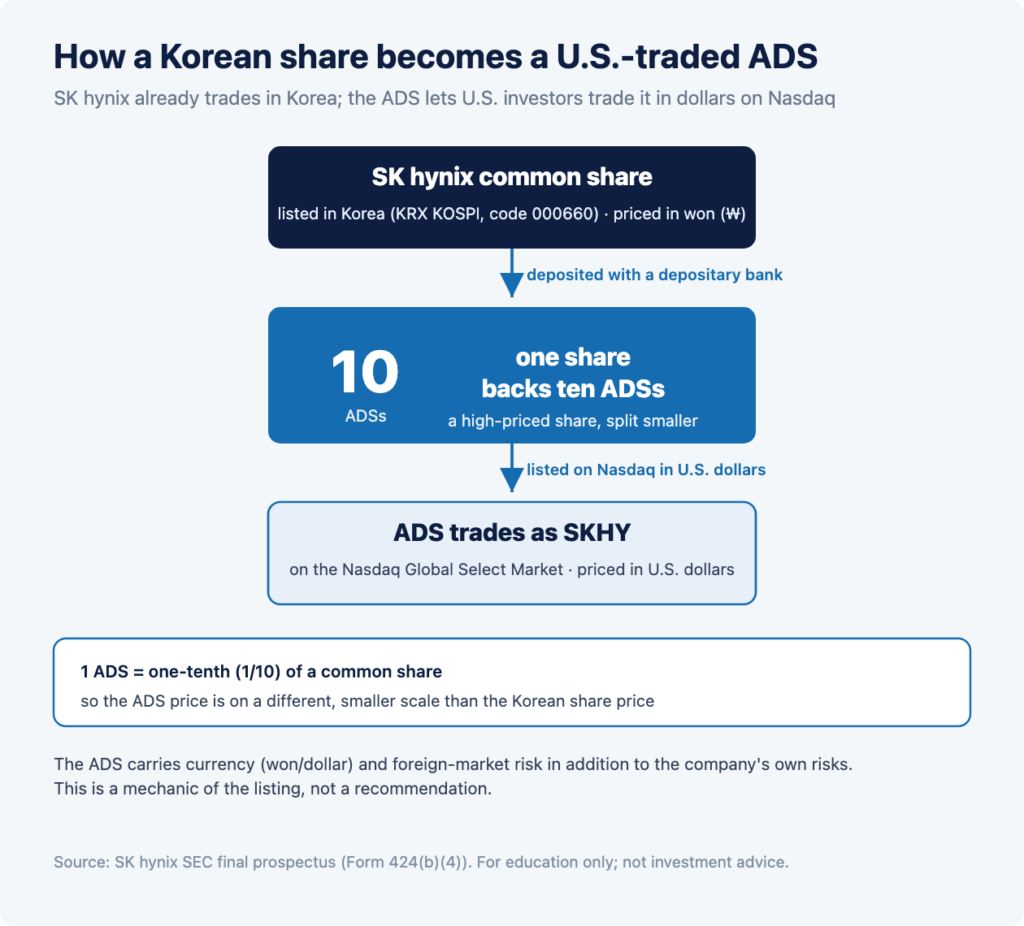
| ADS ratio | 1 ADS = one-tenth (1/10) of a common share |
| Public offering price | US$149.00 per ADS |
| Offering size | US$26,507,100,000 (about US$26.5 billion) |
| Use of proceeds | General corporate purposes, including capital expenditures |
| Lock-up | 90 days (company and certain affiliates) |
| Prospectus date | July 9, 2026 |
| Delivery / closing | On or about July 14, 2026 (third business day after pricing) |
| Already listed | KRX KOSPI Market, Korea (identification code 000660) |
Two figures reported on some calendars ahead of pricing — a “$28 billion” size and a “$158” price — differ from the final prospectus, which sets the price at US$149.00 per ADS and the total at about US$26.5 billion. Where a preliminary figure and the final prospectus disagree, the prospectus governs. The global coordinators for the offering are, per the prospectus, BofA Securities, Citigroup, Goldman Sachs and J.P. Morgan, among others.
Who is SK hynix?
SK hynix is a memory-semiconductor company. In its own prospectus it describes itself as “one of the world’s largest memory semiconductor companies,” engaged in the design, manufacture and sale of DRAM and NAND flash memory. Memory chips store data; they are distinct from the logic chips (such as GPUs) that do the computing.
The reason its listing draws attention is a specific product line: high-bandwidth memory (HBM), the stacked memory used alongside AI accelerators. Per the prospectus, citing market research from IDC, SK hynix ranked second globally in the DRAM market (which includes HBM) with a 29.1% revenue share in the first quarter of 2026, and first globally in the HBM market by revenue. Those are the company’s own filed figures, attributed to IDC; they are not projections.
That places SK hynix in the AI supply chain alongside the logic-chip foundry TSMC and the other major memory makers such as Micron. Its results and its listing are watched as one read on memory demand tied to AI infrastructure — a piece of context, not a prediction about any stock.
Not a startup IPO: what a U.S. listing of an already-public company means
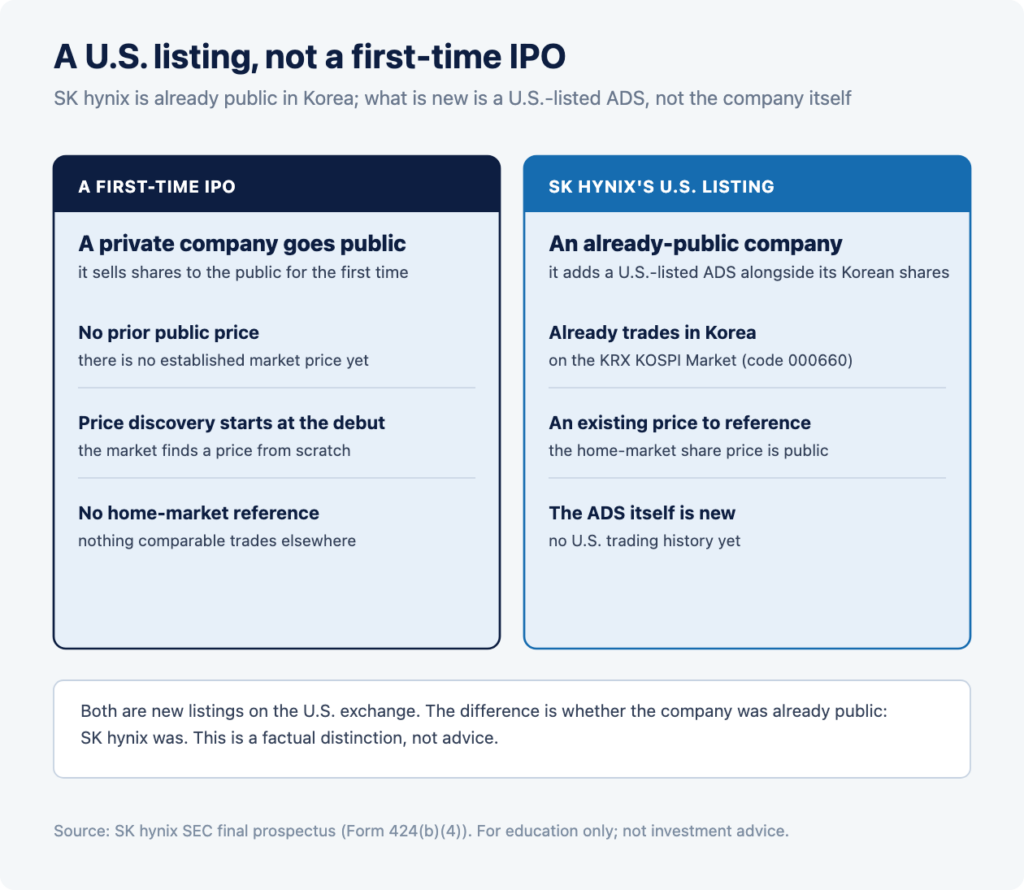
This is the distinction that matters most for reading the event correctly. SK hynix is not a private company going public for the first time. Its common shares already trade on the KRX KOSPI Market in Korea under code 000660; per the prospectus, the last reported price there on July 9, 2026 was 2,186,000 Korean won per common share (about US$1,421 at the exchange rate the prospectus cites). What is new is a U.S.-listed ADS that lets U.S. investors trade an interest in the company in U.S. dollars during U.S. hours.
A few mechanics follow from that:
- ADSs, not ordinary shares. An American Depositary Share is a certificate, issued by a depositary bank, that represents shares of a foreign company. Here, each ADS represents one-tenth of a Korean common share — a ratio chosen because the Korean shares trade at a very high per-share price. So the ADS price (US$149.00 at the offering) is on a different scale from the Korean share price.
- A price reference already exists. Because the common shares already trade in Korea, there is an existing market price the ADS can be compared against — unlike a first-time IPO, where no public price exists before the debut. The prospectus notes, however, that “prior to this offering, there has been no public market for our ADSs.”
- It is still a fresh listing. Even with a Korean reference price, the ADS itself has no U.S. trading history, and currency (won/dollar) and foreign-market factors affect it.
For how a first-time IPO differs from a listing of already-public shares, see our explainer on direct listings versus IPOs (or the upcoming-IPOs hub). The short version: SK hynix’s event is a capital-raising ADS offering by a company that is already public in its home market.
Why now: memory, HBM and the AI build-out
The timing sits inside a broader market narrative: the demand for memory — and HBM in particular — tied to AI data-center build-outs. HBM is the memory that sits next to AI accelerator chips, and supply of it has been widely reported as a bottleneck for AI hardware. Coverage across financial media has framed memory as one of the tighter links in the AI supply chain; that framing is market commentary, attributed to those outlets, not a claim this firm is making or endorsing.
For a company that supplies that memory, a U.S. listing does two things factually: it raises capital (the prospectus states the proceeds are for general corporate purposes, including capital expenditures) and it gives U.S. investors a dollar-denominated way to trade the name. Whether that demand narrative continues, and how any related stock trades, is not something this article predicts. Our AI Stocks 2026 overview maps the broader theme.
How large foreign listings tend to debut
Large foreign-company U.S. listings share some mechanical features worth understanding before the first print, described generally and not as a forecast of this one:
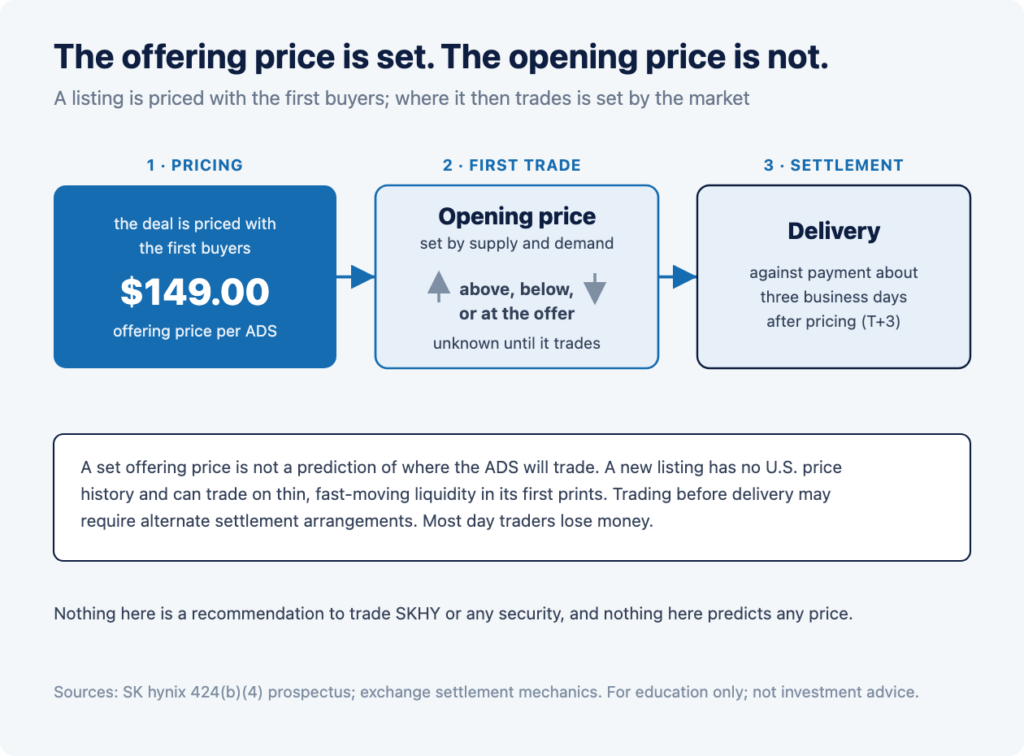
- The offering price is set; the opening price is not. In a bookbuilt offering like this, the underwriters price the deal (here, US$149.00 per ADS) with the initial buyers. The first price at which the ADS trades on the exchange is set by supply and demand at the open and can be above, below, or at the offering price.
- The first prints are often volatile. A brand-new listing has no U.S. trading history and, in its first minutes and days, can trade on thin, fast-moving liquidity as the market discovers a price.
- A home-market reference helps, but does not anchor. Because SK hynix already trades in Korea, participants can watch the Korean price and the won/dollar rate as context. That reference informs, but does not fix, the U.S. price.
These are general mechanics of how new listings behave, not a description of how SKHY will trade.
First-day mechanics and the risks that come with them
A listing day is a specific kind of event, and the risks are specific too. Our guide to how to trade an IPO covers the mechanics in depth; the essentials for a listing like this:
- No trading history. There is no prior U.S. price chart, no established range, and no track record of how the ADS behaves around news.
- Settlement timing. The prospectus states the ADSs are expected to be delivered against payment “on or about July 14, 2026,” the third business day after pricing, and warns that anyone trading before delivery may need to arrange alternate settlement. That is a mechanical detail that can matter in the first days.
- The lock-up. The company and certain affiliates have agreed, subject to exceptions, not to sell ADSs or common shares for 90 days after the prospectus date. Lock-up expiries are watched because they can change the supply of stock available to trade.
- Foreign-issuer risks. Currency (won/dollar) moves, Korean market and regulatory factors, and the ADS structure itself all add risk on top of the company’s own business risks. The prospectus’s risk-factors section begins on page 18 and should be read in full.
Trading a new listing involves substantial risk: prices can move sharply in either direction, liquidity can be thin, and most day traders lose money. Nothing here is a recommendation to trade SKHY or any security.
What traders are watching
Factually, the items market participants tend to focus on around a listing like this:
1. The first trade versus the offering price. The US$149.00 offering price is the reference; where the ADS opens and trades is set by the market.
2. The Korean shares and the won/dollar rate. SK hynix’s KOSPI price (code 000660) and the exchange rate are the home-market context for the ADS.
3. Early liquidity and volatility. Volume, spreads and the speed of the first prints, which tend to be wider and faster than in a seasoned stock.
4. The 90-day lock-up. The date it expires, because it changes tradable supply.
5. The memory and AI-hardware narrative. The demand backdrop the listing sits inside, understood as context rather than a signal.
Watching a listing is not the same as trading it. These are the data points around the event, not a suggestion to take any position.
FAQ
When does SK hynix start trading in the US?
SK hynix priced its U.S. offering on July 9, 2026 (the prospectus date) and is expected to begin trading on the Nasdaq Global Select Market under the ticker SKHY around the listing date; the prospectus states the ADSs are to be delivered against payment on or about July 14, 2026 (the third business day after pricing). Check the exchange and the filing for the exact first-trading date.
What is the SK hynix ticker symbol?
SKHY, on the Nasdaq Global Select Market, per the SEC final prospectus. Its Korean common shares trade separately on the KRX KOSPI Market under code 000660.
How can I buy SK hynix stock in the US?
SKHY is a U.S.-listed Nasdaq security, so it can generally be traded like any other U.S.-listed stock through a brokerage that offers U.S. equities, once it begins trading. Availability of a brand-new listing can vary by broker in the first days, and buying at the open means trading without a prior price history. This is general information, not advice or a recommendation to buy.
Is this an IPO or something else?
It is a U.S. listing of American Depositary Shares by a company that is already publicly traded in Korea, together with a capital-raising ADS offering. It is not a first-time IPO of a private company; SK hynix’s common shares already trade on the KRX KOSPI Market (code 000660).
How big is the SK hynix listing?
Per the final prospectus, the company is offering 177,900,000 ADSs at US$149.00 each, for a total of about US$26.5 billion — one of the year’s largest U.S. market debuts. Each ADS represents one-tenth of a Korean common share.
What is an ADS, and how is it different from the Korean shares?
An American Depositary Share is a U.S.-listed certificate that represents shares of a foreign company and trades in U.S. dollars. Each SK hynix ADS represents one-tenth of a Korean common share, so the ADS price is on a different scale from the KOSPI share price, and it carries currency and foreign-market risk.
Disclosures: Trading involves substantial risk and is not suitable for every investor. New listings can be especially volatile, have no prior trading history, and may trade on thin liquidity in their first days. Capital is at risk and most day traders lose money. Leverage, where offered, amplifies both gains and losses, and you can lose more than you deposit. American Depositary Shares carry currency and foreign-market risk in addition to the underlying company’s risks. Client accounts are not SIPC or FSCS insured. This content is provided for information and education only. It is not investment advice, an offer, a solicitation, or a recommendation of any security, and it does not predict any price or outcome. All deal terms are drawn from SK hynix’s SEC Rule 424(b)(4) final prospectus (filed July 10, 2026); market-share figures are the company’s own, attributed to IDC. See our full disclosures and policies.
<!– CMS: NewsArticle schema — headline, datePublished (2026-07-XX), dateModified (update at listing + post-debut), publisher=CMEG, about=”SK hynix (SKHY) U.S. listing”. FAQPage schema on the FAQ block. Internal links to wire at publish: “how to trade an IPO” → How to Trade an IPO; “direct listings versus IPOs” → Direct Listings vs IPOs (or Upcoming IPOs hub if not live); “AI Stocks 2026” → AI Stocks 2026 pillar; account-opening guide (contextually, non-soliciting); disclosures → /policies/. –>
<!– PUBLISH-DAY REFRESH BOX (5 min):
1. Re-check SK hynix EDGAR (CIK 0002120882) for any post-424B4 filing (e.g., final closing 6-K); confirm the offering table still matches the prospectus.
2. Confirm SKHY’s actual first trading day on Nasdaq; update the direct answer, the “When does SK hynix start trading” FAQ, and the “as of” stamp.
3. LISTING-DAY / POST-DEBUT: convert to past tense; add “how the debut traded” as FACTS ONLY (opening print vs the $149 offering price, first-day range) with the source; keep the ADS-structure, not-a-startup-IPO, and risk sections evergreen. Do NOT add any forecast.
4. The 90-day lock-up expiry date can be computed from the prospectus date (~early October 2026) and noted as a watch-item.
–>