Cerebras Systems, the AI-chip company behind the wafer-scale processor, completed its initial public offering in May 2026 and now trades on the Nasdaq Global Select Market under the ticker CBRS. Per its SEC final prospectus (dated May 14, 2026), the IPO priced at US$185.00 per Class A share and sold 30,000,000 shares, a roughly US$5.55 billion offering. The company keeps founder control through a dual-class structure, and the standard 180-day lock-up is a key date on the calendar. The details below come from the SEC filing. This is factual reporting, not a recommendation on any stock.
Data on this page is drawn from Cerebras’s SEC Rule 424(b)(4) final prospectus (filed May 14, 2026) and is current as of July 10, 2026. It does not state any current market price. It is updated around the lock-up expiry and the first earnings report.
What happened: Cerebras’s IPO, by the numbers
Cerebras Systems Inc. completed its initial public offering in mid-May 2026. Its Class A common stock was approved to list on the Nasdaq Global Select Market under the symbol CBRS, and the final prospectus setting the terms is dated May 14, 2026. The figures below are those final terms.
| Item | Detail (from the prospectus) |
| Company | Cerebras Systems Inc. |
| Ticker / exchange | CBRS / Nasdaq Global Select Market |
| Security | Class A common stock |
| IPO price | US$185.00 per share |
| Shares offered (base) | 30,000,000 (plus an over-allotment option of up to 4,500,000) |
| Offering size (base) | About US$5.55 billion (up to about US$6.38 billion with the over-allotment) |
| Proceeds to Cerebras (base, before expenses) | US$5,419,575,000 |
| Use of proceeds | Broad discretion; about US$416.1 million earmarked for RSU tax-withholding obligations |
| Lock-up | 180 days after the prospectus date (subject to customary exceptions) |
| Structure | Three classes of stock (Class A / B / N); emerging-growth company |
At US$185.00 per share for 30,000,000 shares, the base deal raised about US$5.55 billion, one of the larger technology IPOs of the year. Because the offering is complete, CBRS now trades like any other Nasdaq-listed stock. This article does not state its current price; the numbers here are the IPO terms, which are fixed, not the market price, which changes.
What is Cerebras, and what does it make?
Cerebras is an AI-compute company. Its signature product, described in its prospectus, is the Wafer-Scale Engine (WSE) — a processor built on a single silicon wafer rather than cut into many small chips. Per the filing, the third-generation WSE-3 packs about 4 trillion transistors and 900,000 cores on roughly 46,225 square millimetres of silicon, fabricated on a 5-nanometre process at the foundry TSMC.
The idea is an architectural bet: where most AI systems string together many separate graphics processors (GPUs), Cerebras puts an enormous amount of compute and memory on one wafer-scale part, aiming to move data faster within a single chip. That is a description of the approach, drawn from the company’s own materials — not a claim that it is better or worse than GPU-based systems, and not a view on the stock.
One supply-chain detail is worth noting because it ties the AI-hardware names together: like the GPUs it is an alternative to, Cerebras’s wafer is manufactured by TSMC. The foundry sits upstream of the whole complex, which is part of why TSMC’s results are watched as an AI-supply-chain signal.
Where Cerebras fits in the AI-chip IPO pipeline
Cerebras’s listing is one of several AI-hardware capital-markets events clustered in 2026, a stretch in which memory and compute names have come to public markets against the backdrop of AI data-centre demand. Its debut sits alongside other large AI-adjacent listings and the memory-chip names, and its supplier, TSMC, reports through the same window.
For a trader, the useful framing is a factual one: a wave of AI-hardware companies becoming publicly traded means more new tickers with short trading histories, dual-class structures, and lock-up calendars to track — the mechanics below apply to most of them. It does not imply anything about how any of these stocks will trade. Our AI Stocks 2026 overview maps the broader theme.
The dual-class structure: who controls the votes
Cerebras went public with three classes of common stock, a common arrangement for founder-led technology companies. Per the prospectus:
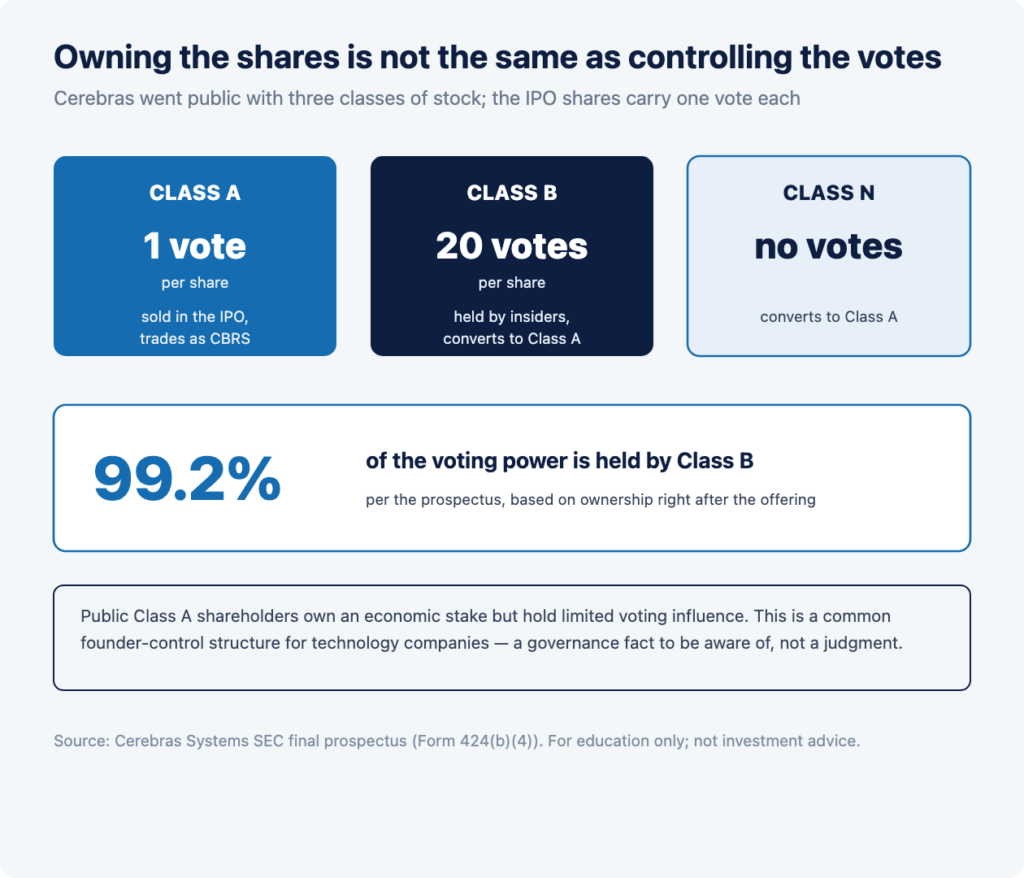
- Class A (the shares sold in the IPO and the ones traded under CBRS) carries one vote per share.
- Class B carries 20 votes per share and converts into Class A.
- Class N is non-voting and converts into Class A.
The consequence, stated in the filing: based on beneficial ownership as of March 31, 2026, holders of Class B stock will control approximately 99.2% of the voting power after the offering. For a shareholder, that is a governance fact worth understanding — public Class A holders own an economic stake but have limited voting influence. It is a structural feature to be aware of, not a judgment about the company.
The lock-up, and why it is a date to watch
The prospectus sets a 180-day lock-up period after the prospectus date, during which the company and pre-IPO holders agree, subject to customary exceptions, not to sell shares. With a mid-May 2026 pricing, that lock-up runs to roughly November 2026 (the exact date follows from the prospectus date; some early-release provisions apply).
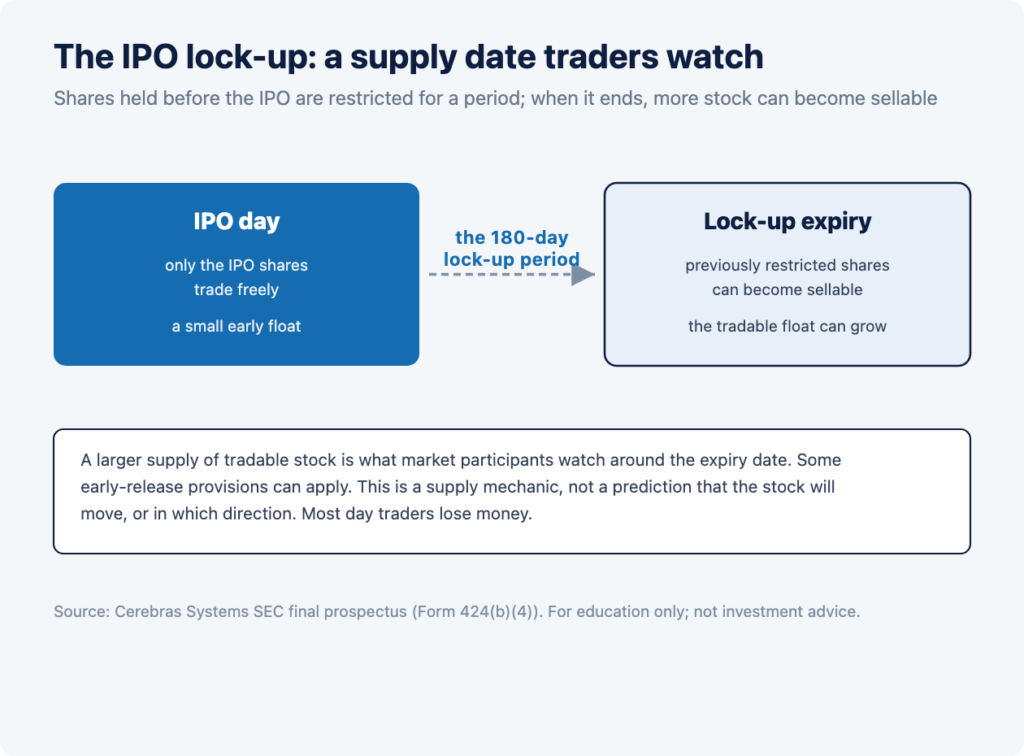
Lock-up expiries are watched because they change the supply of stock available to trade: shares that were restricted can become sellable, which market participants track as a potential shift in float. That is a mechanic to be aware of around the date; it is not a prediction that the stock will move, or in which direction.
What “recently public” means for trading
A stock that has been public for only a short time behaves differently from a seasoned one, and the differences are worth understanding before trading it. Our guide to how to trade an IPO covers this in depth; the essentials:
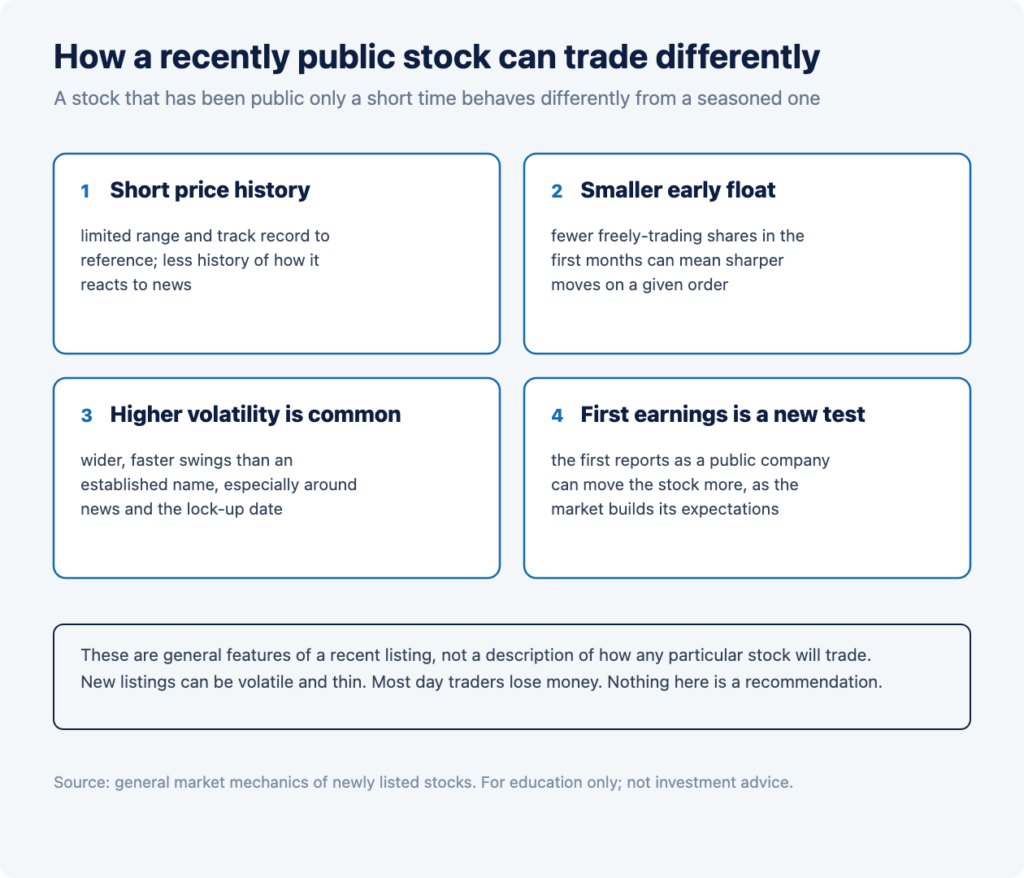
- A short price history. There is limited trading history to reference, no long-run range, and less of a track record for how the stock reacts to news.
- A smaller early float. In the first months, only the IPO shares (and any early-released stock) trade freely; a smaller float can mean sharper moves on a given amount of buying or selling.
- Higher volatility is common. New listings frequently see wider swings and faster moves than established names, especially around news and the lock-up date.
- The first earnings report is a new data point. A newly public company’s first few reports as a public company can move the stock more than a routine quarter, because the market is still building its expectations.
Trading a recently public stock involves substantial risk: prices can move sharply in either direction, and most day traders lose money. Nothing here is a recommendation to trade CBRS or any security.
What traders watch
Factually, the items market participants tend to focus on with a recently public name like this:
1. The lock-up expiry date — roughly 180 days after the May 2026 pricing, because it can change the tradable supply.
2. The first earnings reports — the first read on the business as a public company.
3. Float and volume — how much stock trades freely and how liquid it is day to day.
4. The AI-hardware backdrop — the demand narrative the name sits inside, understood as context rather than a signal.
5. The dual-class structure — a governance factor for any shareholder.
Watching a stock is not the same as trading it. These are the data points around a recent listing, not a suggestion to take any position.
Risks
Trading a recently public company involves substantial risk. There is a limited trading history, the early float can be small, and volatility is often elevated — particularly around news and the lock-up expiry, when previously restricted shares can become available to sell. A dual-class structure means public shareholders have limited voting power. As an emerging-growth company, Cerebras may use reduced public-company reporting for a period, so less information may be available than for a longer-established issuer.
Prices can move sharply in either direction, liquidity can be thin, and most day traders lose money. Nothing on this page is a recommendation to trade CBRS or any security, and nothing here predicts any price or outcome.
FAQ
Is Cerebras publicly traded?
Yes. Cerebras Systems completed its IPO in May 2026 and its Class A common stock trades on the Nasdaq Global Select Market under the ticker CBRS, per the company’s SEC final prospectus (dated May 14, 2026).
What was the Cerebras IPO price?
US$185.00 per Class A share, per the final prospectus. The base offering sold 30,000,000 shares (with an over-allotment option of up to 4,500,000 more), raising about US$5.55 billion before the option.
What does Cerebras make?
AI-compute hardware. Its main product is the Wafer-Scale Engine (WSE), a processor built on a single silicon wafer; per the filing, the WSE-3 has about 4 trillion transistors and 900,000 cores and is fabricated by TSMC on a 5-nanometre process. It is an alternative architecture to GPU-based AI systems.
When does the Cerebras lock-up expire?
The prospectus sets a 180-day lock-up after the prospectus date. With a mid-May 2026 pricing, that points to roughly November 2026 (the exact date follows from the prospectus date, and some early-release provisions apply). Lock-up expiries are watched because they can change the supply of tradable stock.
Why does Cerebras have more than one class of stock?
It has three classes (A, B and N). Class A, traded as CBRS, has one vote per share; Class B has 20 votes and converts to Class A; Class N is non-voting. Per the prospectus, Class B holders control about 99.2% of the voting power — a common founder-control structure for technology companies.
How can I trade CBRS?
CBRS is a Nasdaq-listed stock, so it can generally be traded like any other U.S.-listed stock through a brokerage that offers U.S. equities. A recently public stock can be volatile and has a limited trading history. This is general information, not advice or a recommendation to buy or sell.
Disclosures: Trading involves substantial risk and is not suitable for every investor. Recently public companies can be especially volatile, have a limited trading history, and may have a small early float. Capital is at risk and most day traders lose money. Leverage, where offered, amplifies both gains and losses, and you can lose more than you deposit. Client accounts are not SIPC or FSCS insured. This content is provided for information and education only. It is not investment advice, an offer, a solicitation, or a recommendation of any security, and it does not predict any price or outcome. All IPO terms are drawn from Cerebras Systems’ SEC Rule 424(b)(4) final prospectus (filed May 14, 2026); no current market price is stated. See our full disclosures and policies.
<!– CMS: NewsArticle schema — headline, datePublished, dateModified (update at lock-up expiry + first earnings), publisher=CMEG, about=”Cerebras Systems (CBRS) IPO”. FAQPage schema on the FAQ block. Internal links to wire at publish: “how to trade an IPO” → How to Trade an IPO; “AI Stocks 2026 overview” → AI Stocks 2026 pillar; TSMC reference → TSMC Earnings hub; disclosures → /policies/. –>
<!– PUBLISH-DAY REFRESH BOX (5 min):
1. Re-check Cerebras EDGAR (CIK 0002021728) for any post-IPO filing (10-Q, 8-K, lock-up news); confirm the IPO table still matches the 424B4.
2. Compute the exact 180-day lock-up expiry from the prospectus date and state it precisely as a watch-item (do NOT forecast around it).
3. Update the “as of” stamp. Keep NO current market price / performance figure in the piece (compliance).
4. On the first Cerebras earnings report as a public company, add a factual “first-earnings” note and link the How Earnings Move Stocks pillar.
–>