

The Federal Reserve Bank of Kansas City holds its annual Economic Policy Symposium in Jackson Hole, Wyoming on August 27 to 29, 2026, under the topic “Financial Innovation: Implications for Payments and Policy.” It is an invitation-only research conference, not a policy meeting. No interest-rate decision is made there. The Federal Open Market Committee’s next scheduled decision is September 15 to 16, 2026.
Data as of August 19, 2026. Figures are historical and are not a forecast.
What is the Jackson Hole Economic Policy Symposium?
The symposium is an annual research conference hosted by the Federal Reserve Bank of Kansas City. According to the Bank, its purpose is “to bring together central bankers, policymakers, economists, and academics from across the globe to discuss and share insights on important economic issues and long-term policy challenges.”[^1]
It is a conference about ideas, not a meeting at which anything is decided. That distinction is the single most useful thing for a market participant to understand about the event, and it is the reason the rest of this article spends more time on format and calendar than on speculation.
The Kansas City Fed has sponsored the symposium each year since 1978.[^2] The Bank describes it as “one of the longest-standing central banking conferences globally, with a history spanning over 48 years.”[^1]
That longevity is part of why the event carries the attention it does. A conference that has run annually for nearly five decades accumulates a body of published research, and the Kansas City Fed compiles the papers and transcripts into proceedings volumes that remain accessible on its website.[^2] The symposium’s output is therefore a research archive as much as an annual news event, and the Bank publishes a short history of it under the title “In Late August.”[^1]
What the symposium is for
The Bank’s own framing is worth reading closely, because it sets expectations correctly. The stated purpose concerns “important economic issues and long-term policy challenges.”[^1] Long-term is the operative phrase. The papers commissioned for the symposium tend to address structural questions, and the 2026 topic, financial innovation in payments, fits that description.
None of this rules out remarks on current conditions. It does mean that the event is designed around research on multi-year questions rather than around the next policy decision, and a reader expecting the latter is working from a mistaken premise about what the conference is.
Who actually attends
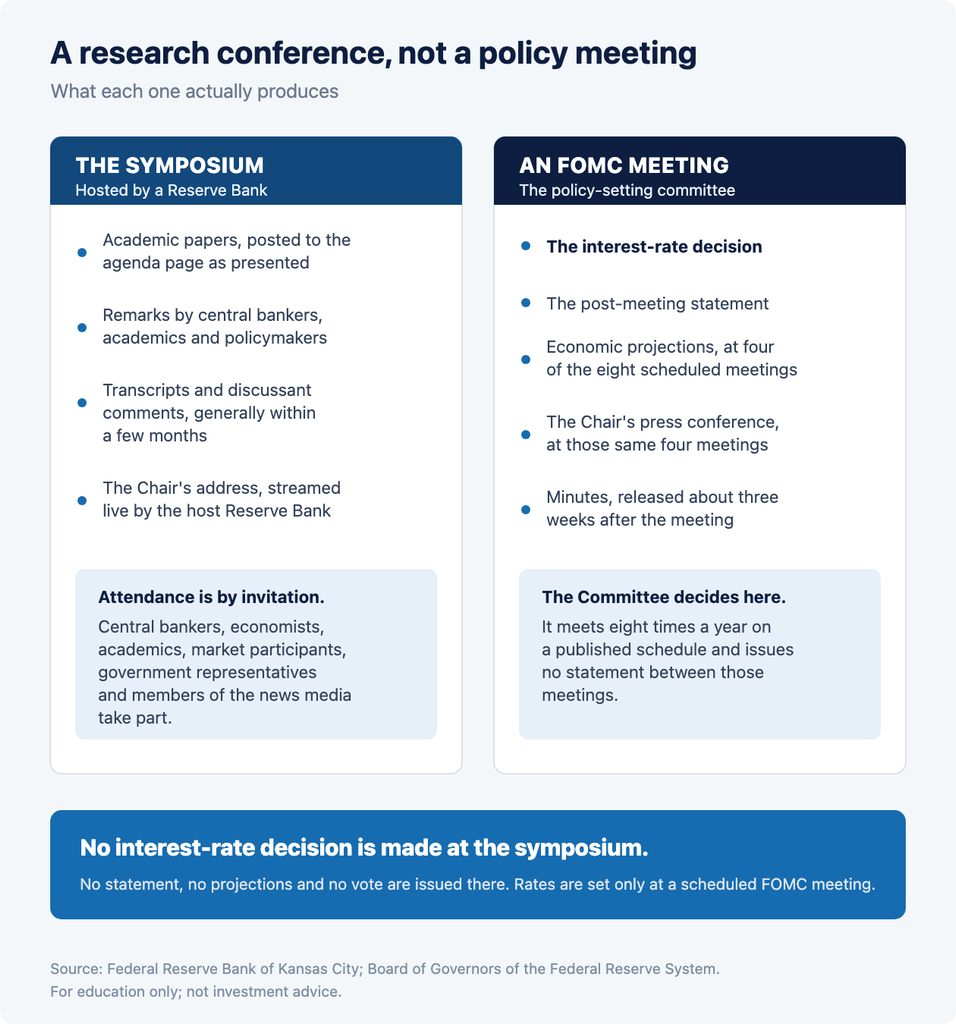
Attendance is by invitation. The Kansas City Fed lists participants as “representatives from central banks around the world, economists, financial market participants, academics, U.S. government representatives, and members of the news media.”[^1]
The Bank states that participation is limited by invitation “to ensure that the discussions remain focused and productive, allowing participants to engage in open and candid discussions about important economic issues without external distractions.”[^1] More than a dozen media outlets are invited.[^1]
How it is funded
The Kansas City Fed recovers the symposium’s costs through attendee fees. Participants pay fees covering the event’s expenses and are separately responsible for their own travel, lodging and personal costs.[^1]
When is the 2026 symposium, and what is the topic?
The Kansas City Fed states plainly on its own FAQ page: “The 2026 Jackson Hole Economic Policy Symposium will take place Aug. 27-29. The topic is ‘Financial Innovation: Implications for Payments and Policy.'”[^1]
The topic is chosen annually and frames the papers presented. Recent themes, from the Bank’s proceedings archive:[^2]
| Year | Topic |
| 2026 | Financial Innovation: Implications for Payments and Policy |
| 2025 | Labor Markets in Transition: Demographics, Productivity and Macroeconomic Policy |
| 2024 | Reassessing the Effectiveness and Transmission of Monetary Policy |
| 2023 | Structural Shifts in the Global Economy |
| 2022 | Reassessing Constraints on the Economy and Policy |
The 2026 topic is worth noting for its subject matter rather than for any policy implication. Payments infrastructure and financial innovation are supervisory and structural questions. A symposium organised around them is not, on its face, organised around the near-term path of interest rates.
What is the format of the event?
The Kansas City Fed describes the format as “presentations, panel discussions, and Q&A sessions,” providing “a platform for in-depth discussions on various economic topics and policy issues.”[^1]
Three things are published, and knowing which is which prevents a common misreading:
- Papers. Academic papers presented at the symposium are posted to the event’s agenda page when they are presented.[^1]
- Transcripts and discussant comments. These are posted “as available, generally within a few months,” and are later compiled into proceedings books.[^1]
- The Chair’s address. Since 2020, the Federal Reserve Chair’s address at the symposium has been streamed live through the Kansas City Fed’s YouTube channel.[^1]
Where the material appears
For anyone trying to follow the event from outside, the livestream of the Chair’s address and the agenda page are the two primary access points, both operated by the Kansas City Fed itself. Papers appear on the agenda page as they are presented; the fuller record follows over subsequent months.
Why does a conference with no policy decision draw market attention?
Because the calendar leaves a gap, and because senior officials speak in public within it.
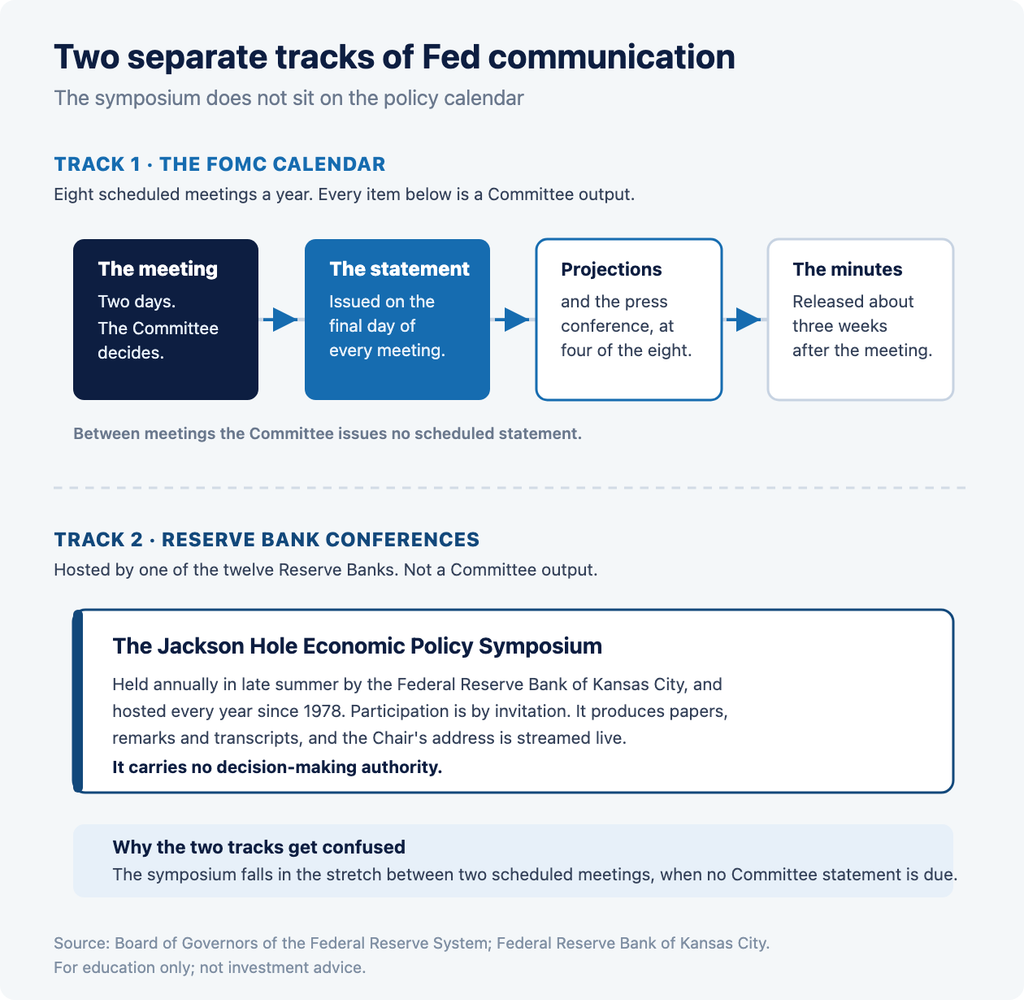
The Federal Open Market Committee meets eight times a year on a published schedule. Between meetings, the Committee issues no statement. The symposium falls in late August, which in most years places it between the July and September meetings, a stretch of several weeks with no scheduled Committee communication.
That is a structural observation, not a claim about content. Market participants have historically paid attention to public remarks by Federal Reserve officials made outside meeting weeks, and the symposium is one of the larger scheduled occasions on which such remarks occur. What is said, and whether it changes anything, is not knowable in advance and is not predicted here.
What is not announced at Jackson Hole
To be explicit, because the misconception is common:
- No interest-rate decision. Rates are set by the FOMC at its scheduled meetings.
- No policy statement. The post-meeting statement is an FOMC document, issued only after a meeting.
- No Summary of Economic Projections. The SEP accompanies four of the eight annual meetings, not the symposium.
- No vote of any kind. The symposium has no decision-making authority.
Where does the symposium sit in the 2026 Federal Reserve calendar?
Immediately before a projections meeting. The Federal Reserve publishes its FOMC calendar, and the September meeting is one of the four in 2026 that carries a Summary of Economic Projections and a press conference.[^3]
Date | Event | Projections and press conference |
| Aug 27-29, 2026 | Jackson Hole Economic Policy Symposium (Kansas City Fed) | Not applicable – not an FOMC event |
| Sep 15-16, 2026 | FOMC meeting | Yes |
| Oct 7, 2026 | Minutes of the September meeting released | – |
| Oct 27-28, 2026 | FOMC meeting | No |
| Nov 18, 2026 | Minutes of the October meeting released | – |
| Dec 8-9, 2026 | FOMC meeting | Yes |
| Dec 30, 2026 | Minutes of the December meeting released | – |
The sequence matters for anyone building a calendar: the symposium runs August 27 to 29, and the next scheduled policy decision follows roughly two and a half weeks later, on September 16, accompanied by updated projections.
Where do US interest rates stand going into the 2026 symposium?
The federal funds target range is 3.50% to 3.75%. It has been at that level since December 11, 2025, according to the Federal Reserve Bank of St. Louis’s published series for the upper and lower bounds of the target range.[^4]
The path to that level ran through three reductions in the second half of 2025:[^4]
- September 18, 2025: the range moved to 4.00% to 4.25%
- October 30, 2025: to 3.75% to 4.00%
- December 11, 2025: to 3.50% to 3.75%
The range has been unchanged since. That is a fact about where policy is, not a statement about where it goes next.
The 2-year Treasury yield
The 2-year Treasury constant-maturity yield was 4.19% on August 17, 2026, the most recent observation available at the time of writing.[^5]
Market participants commonly reference shorter-dated Treasury yields when discussing interest-rate expectations, because a two-year instrument spans several policy meetings. Readers should note that the 2-year yield and the federal funds target range are different quantities measured in different ways: one is a market price that changes continuously, the other an administered range set by the Committee. They are not required to agree, and comparing them is not a forecast.
How have markets behaved during past symposium weeks?
Inconsistently, which is the point of showing the data rather than describing it.
The table below records the 2-year Treasury yield across the Monday-to-Friday trading week containing each of the past four symposiums. Each year’s symposium dates were confirmed individually against the Kansas City Fed’s own page for that year.[^6] It is presented as history. It is not a pattern to trade on, and nothing in it implies what will happen in 2026.
| Year | Symposium dates | Trading week shown | Mon | Tue | Wed | Thu | Fri | Change across the week |
| 2022 | Aug 25-27 | Aug 22-26 | 3.32 | 3.29 | 3.36 | 3.35 | 3.37 | +0.05 |
| 2023 | Aug 24-26 | Aug 21-25 | 4.97 | 5.02 | 4.95 | 4.98 | 5.03 | +0.06 |
| 2024 | Aug 22-24 | Aug 19-23 | 4.06 | 3.99 | 3.92 | 3.99 | 3.90 | -0.16 |
| 2025 | Aug 21-23 | Aug 18-22 | 3.77 | 3.75 | 3.74 | 3.79 | 3.68 | -0.09 |
Two of the four weeks ended higher and two ended lower. The largest weekly change in the set is 16 basis points. There is no consistent direction, and four observations would not establish one even if there were.
This is the sort of table that is easy to over-read. A yield moving during a week in which a conference took place does not establish that the conference moved it. Economic data, Treasury supply, positioning and events elsewhere in the world all affect the same series in the same window, and none of them are separated out here.
The method is also worth stating rather than hiding. Each row covers the full Monday-to-Friday trading week in which that year’s symposium fell, not the single day of any address. That keeps the comparison consistent across years in which the conference began on different weekdays, but it also means the table is not isolating a single event. It is measuring a week, and a week contains a great deal besides a conference.
A reader who wanted to examine this more carefully could pull the same FRED series and narrow the window to each year’s specific address day. That is the appropriate response to a table like this one: check it, rather than accept it.
Where the 2-year yield stands relative to policy
As of August 17, 2026, the 2-year yield of 4.19% sat above the 3.75% upper bound of the federal funds target range.[^4][^5] The two quantities are constructed differently, as noted above, and the gap between them is reported here as an observation rather than interpreted. Readers should not take a difference between a market-determined yield and an administered policy range as a signal about a future decision.
How does the market commonly read Federal Reserve communication outside meeting weeks?
Through instruments that reprice continuously rather than through announcements.
Between FOMC meetings, the Committee makes no scheduled statement. Market participants therefore commonly reference two published quantities when discussing rate expectations: shorter-dated Treasury yields, such as the 2-year, and federal funds futures. Pricing derived from federal funds futures is published by CME Group and is widely quoted.
Two cautions apply to any such reference, and both are worth stating plainly:
Market pricing is not a forecast by the Federal Reserve. It reflects what participants in a market are willing to transact at, and it changes daily. The Committee decides at its meetings; pricing beforehand describes expectations, not outcomes.
Speeches are not policy. Remarks by an individual official represent that official’s views. The Committee acts collectively at scheduled meetings, and the record of what it decided is the statement and, at four meetings a year, the projections.
What are the Federal Reserve’s scheduled communication channels?
Several, each with its own timetable, and the symposium is not one of them. Distinguishing between them is what keeps a calendar accurate.
| Channel | Issued by | Timing |
| Post-meeting statement | The FOMC | The final day of each of the eight scheduled meetings |
| Press conference | The Chair | Following meetings associated with projections |
| Summary of Economic Projections | FOMC participants | Four of the eight annual meetings, including September 15-16 and December 8-9, 2026 |
| Meeting minutes | The FOMC | Approximately three weeks after each meeting; October 7, November 18 and December 30, 2026 |
| Jackson Hole address | The Chair, at a Kansas City Fed conference | Annually in late August; livestreamed since 2020 |
The first four rows are FOMC outputs on the Committee’s own calendar. The fifth is a speech at a conference hosted by one of the twelve Reserve Banks. They are different categories of document, and only the first four carry the Committee’s collective position.
Why the September meeting is a fuller information event
The September 15 to 16 meeting is one of the four in 2026 that carries a Summary of Economic Projections.[^3] That means it produces a statement, a set of participant projections and a press conference, rather than a statement alone.
For a reader building a calendar, that is the more consequential distinction than anything about the symposium: a projections meeting publishes more material than a non-projections meeting, and October 27 to 28 is a non-projections meeting while December 8 to 9 is a projections meeting.[^3]
What does this mean for an active trader’s calendar?
It means the symposium is a date to know rather than an event to position around.
The practical, checkable facts are these. The symposium runs August 27 to 29, 2026. The Chair’s address has been streamed live on the Kansas City Fed’s YouTube channel since 2020. Papers appear on the agenda page as presented. No rate decision, statement or projection is issued. The next scheduled FOMC decision, with projections, is September 16, 2026.
Everything beyond that list is interpretation, and interpretation offered in advance of an event is speculation regardless of who offers it.
The wider September calendar
The symposium sits at the front of an unusually dense stretch of scheduled US data. Every date below is drawn from the issuing agency’s own published calendar.
| Date | Time (ET) | Release | Agency |
| Sep 1 | 10:00 a.m. | Job Openings and Labor Turnover Survey, July | BLS |
| Sep 4 | 8:30 a.m. | Employment Situation, August | BLS |
| Sep 7 | – | Labor Day, US markets closed | – |
| Sep 10 | 8:30 a.m. | Producer Price Index, August | BLS |
| Sep 11 | 8:30 a.m. | Consumer Price Index, August | BLS |
| Sep 15-16 | – | FOMC meeting, with projections and press conference | Federal Reserve |
| Sep 16 | 8:30 a.m. | Advance Monthly Retail Trade, August | Census |
| Sep 29 | 10:00 a.m. | Job Openings and Labor Turnover Survey, August | BLS |
| Sep 30 | 8:30 a.m. | Personal Income and Outlays, August, containing the PCE price index | BEA |
| Sep 30 | 8:30 a.m. | Gross Domestic Product, third estimate, second quarter | BEA |
Two features of that calendar are worth flagging because they are easy to get wrong from memory.
The Producer Price Index precedes the Consumer Price Index in September, on the 10th and 11th respectively, reversing the more common order in which CPI is published first. Anyone working from a remembered sequence rather than the published BLS schedule may have those two the wrong way round.
September 16 carries two scheduled items in the same session, with retail sales released at 8:30 a.m. and the FOMC decision following in the afternoon. Sessions containing more than one scheduled release are not unusual, and the observation here is simply that the calendar shows both.
How do sessions containing scheduled events differ mechanically?.
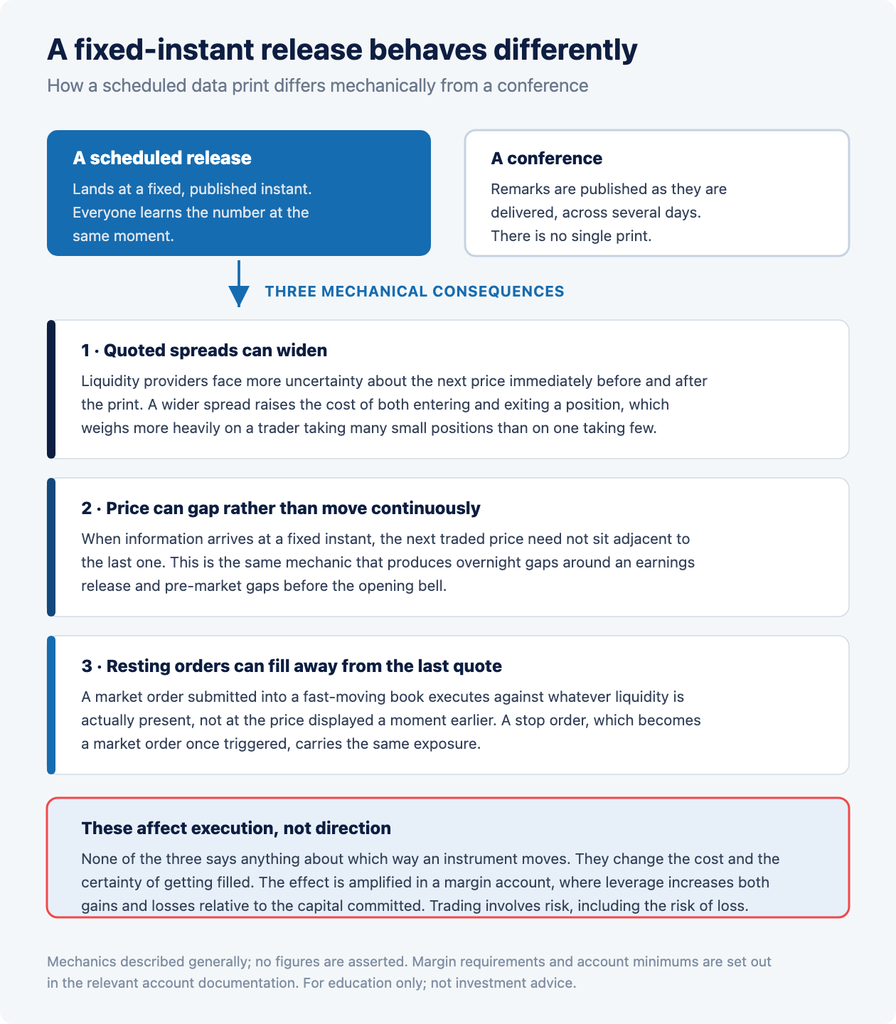
In how orders meet the market, rather than in direction.
A scheduled announcement concentrates activity into a known moment. Three mechanical consequences follow, and they are properties of market structure rather than predictions about price.
Bid-ask spreads can widen around the announcement. Liquidity providers face greater uncertainty about the next print immediately before and after a scheduled release, and quoted spreads have historically reflected that. A wider spread raises the cost of entering and exiting, which matters more to a trader taking many small positions than to one taking few large ones.
Prices can gap rather than move continuously. When information arrives at a fixed instant, the next traded price need not be adjacent to the last. This is the same mechanic that produces overnight gaps around earnings releases, described in more detail in our article on how earnings move stocks, and the mechanic that produces pre-market gaps discussed in our article on pre-market movers.
Orders resting in the book may fill at prices away from the last quote. A market order submitted into a fast-moving book executes against whatever liquidity is present, not at the price displayed a moment earlier. Stop orders, which become market orders when triggered, carry the same exposure.
What this implies for account risk
These mechanics affect the cost and certainty of execution, not the direction of any instrument. Their practical significance is that a position sized on the assumption of continuous pricing and a normal spread may behave differently in a session containing a scheduled event.
The effect is amplified in a margin account. Leverage increases both gains and losses relative to the capital committed, and a gap that moves against a leveraged position can produce a loss larger than the same move would produce in an unleveraged one. Margin requirements, account minimums and the treatment of margin calls are set out in the relevant account documentation and should be read before trading on margin.
The symposium itself, it is worth repeating, is not a scheduled release in this sense. It produces no data print at a fixed instant. The September 4 employment report, the September 10 and 11 inflation releases and the September 16 FOMC decision are scheduled releases; the symposium is a conference whose remarks are published as they are delivered.
Risks and limitations
Several limitations apply to everything above, and they are not boilerplate.
Scheduled events change. Dates and formats are published by the issuing institutions and can be revised. The dates here were confirmed against the Kansas City Fed and Federal Reserve calendars on August 19, 2026, and should be re-checked against those sources before being relied upon.
Historical data does not describe the future. Table 3 records what a specific Treasury series did in four past weeks. It carries no information about 2026 and is not offered as a guide to any outcome.
Correlation in a table is not causation in a market. Many factors move interest rates in any given week. Attributing a move to a conference is not supportable from the data shown.
Trading involves risk of loss. Volatility around scheduled events can widen spreads and produce gaps between sessions. Losses can exceed expectations, particularly in leveraged accounts, where both gains and losses are amplified relative to the capital committed. Account minimums, margin requirements and product availability vary and are set out in the relevant account documentation.
Nothing here is investment advice. This article reports scheduled dates, published institutional descriptions and historical data. It makes no recommendation about any security, instrument or course of action.
Frequently asked questions
When is the Jackson Hole Symposium in 2026?
The Federal Reserve Bank of Kansas City has stated that the 2026 Jackson Hole Economic Policy Symposium takes place on August 27 to 29, 2026. The announced topic is “Financial Innovation: Implications for Payments and Policy.” Dates are published by the Kansas City Fed and should be confirmed there.
Does the Federal Reserve set interest rates at Jackson Hole?
No. The symposium is a research conference hosted by the Federal Reserve Bank of Kansas City and has no decision-making authority. Interest rates are set by the Federal Open Market Committee at its scheduled meetings. The next such meeting is September 15 to 16, 2026.
Can the public attend the Jackson Hole Symposium?
No. The Kansas City Fed states that participation in the symposium is by invitation only, in order to keep discussions focused and to allow participants to engage candidly. Listed attendees include representatives from central banks around the world, economists, financial market participants, academics, US government representatives and members of the news media.
Where can the Chair’s Jackson Hole address be watched?
The Kansas City Fed states that since 2020 the Federal Reserve Chair’s address at the symposium has been streamed live through the Bank’s YouTube channel. Papers presented at the symposium are posted to the event’s agenda page at the time they are presented.
What is the Federal Reserve’s interest rate before the 2026 symposium?
The federal funds target range is 3.50% to 3.75%, unchanged since December 11, 2025, per the Federal Reserve Bank of St. Louis’s published series for the target range bounds. This describes where policy stands and does not indicate where it moves next.
Is Jackson Hole the same thing as an FOMC meeting?
No. An FOMC meeting is a scheduled policy meeting of the Federal Open Market Committee that produces a statement and, at four meetings a year, projections and a press conference. Jackson Hole is a research conference hosted by the Federal Reserve Bank of Kansas City and produces papers and remarks.
How long has the Jackson Hole Symposium been held?
The Federal Reserve Bank of Kansas City has sponsored the symposium each year since 1978. The Bank describes it as one of the longest-standing central banking conferences globally, with a history spanning over 48 years, convened to discuss long-term economic policy challenges.
Sources
[^1]: Federal Reserve Bank of Kansas City, “Jackson Hole FAQs,” kansascityfed.org/research/jackson-hole-economic-symposium/jackson-hole-faqs/. Retrieved August 19, 2026. Source for the 2026 dates and topic, the stated purpose, attendance and invitation policy, funding, format, publication of papers and transcripts, the livestream policy since 2020, and the “over 48 years” description.
[^2]: Federal Reserve Bank of Kansas City, “Economic Symposium Proceedings,” kansascityfed.org/research/jackson-hole-economic-symposium/economic-symposium-conference-proceedings/. Retrieved August 19, 2026. Source for “Each year since 1978” and the 2022-2025 topics.
[^3]: Board of Governors of the Federal Reserve System, “FOMC Calendars, Statements, and Minutes,” federalreserve.gov/monetarypolicy/fomccalendars.htm. Retrieved August 19, 2026. Source for the 2026 meeting dates, which meetings are associated with a Summary of Economic Projections, and the minutes release dates.
[^4]: Federal Reserve Bank of St. Louis, FRED series DFEDTARU (Federal Funds Target Range – Upper Limit) and DFEDTARL (Federal Funds Target Range – Lower Limit), retrieved via the FRED API endpoint fred/series/observations on August 19, 2026. The FRED API requires an API key and is therefore not publicly reproducible from a bare link; the underlying series are viewable without a key at fred.stlouisfed.org/series/DFEDTARU and fred.stlouisfed.org/series/DFEDTARL. API documentation: fred.stlouisfed.org/docs/api/fred/. Raw responses retained.
[^6]: Federal Reserve Bank of Kansas City, individual symposium pages: 2025 (kansascityfed.org/research/jackson-hole-economic-symposium/2025/, “August 21, 2025 – August 23, 2025”); 2024 (“Reassessing the Effectiveness and Transmission of Monetary Policy,” August 22-24, 2024); 2023 (“Structural Shifts in the Global Economy,” August 24-26, 2023); 2022 (“Reassessing Constraints on the Economy and Policy,” August 25-27, 2022). All retrieved August 19, 2026.
[^5]: Federal Reserve Bank of St. Louis, FRED series DGS2 (Market Yield on U.S. Treasury Securities at 2-Year Constant Maturity), retrieved via the FRED API endpoint fred/series/observations on August 19, 2026. Key-gated as above; series viewable at fred.stlouisfed.org/series/DGS2. Raw responses retained.
This article is published by Capital Markets Elite Group (KY) Limited for informational and educational purposes only. It does not constitute investment advice, a recommendation, or an offer or solicitation to buy or sell any security or financial instrument. Trading involves risk, including the risk of loss. Past performance and historical data are not indicative of future results. Figures are stated as of the dates shown and may change. Readers should consider their own circumstances and consult a qualified professional where appropriate. See our full terms at /policies/.