

September is an off-cycle earnings month. Most S&P 500 companies report on a calendar-year schedule and sit between quarters, while a set of large companies with non-calendar fiscal years report during it. Only three of the month’s headline names had confirmed their dates at the time of writing. The next full reporting season begins in mid-October.
Data as of August 19, 2026. Dates change; confirm each against the company’s own investor-relations site.
What does the September 2026 earnings calendar look like?
Sparse at the top, and less settled than most published calendars suggest.
The table below carries a column most earnings calendars do not: whether the company itself has announced the date, or whether the date is a data provider’s inference from past reporting patterns. Each row was checked individually against the company’s own investor-relations material.
| Date | Company | Session | Fiscal period | Consensus EPS | Date status |
| Sep 1 | Medtronic | Not stated | Q1 FY2027 | $1.40 | Provider projection |
| Sep 2 | Broadcom | After the close | Q3 FY2026 | $3.30 | Company-confirmed |
| Sep 2 | Hewlett Packard Enterprise | After the close | Q3 FY2026 | $0.93 | Provider projection |
| Sep 3 | Dell Technologies | Not stated | Q2 FY2027 | $4.99 | Provider projection |
| Sep 9 | Kroger | Not stated | Q2 FY2027 | $1.09 | Provider projection |
| Sep 10 | Adobe | After the close | Q3 FY2026 | $6.20 | Company-confirmed |
| Sep 14 | Oracle | Not stated | Q1 FY2027 | $1.77 | Window only – see below |
| Sep 16 | FedEx | Not stated | Q1 FY2027 | $4.05 | Provider projection |
| Sep 17 | Lennar | After the close | Q3 FY2026 | $1.31 | Provider projection |
| Sep 21 | Micron Technology | After the close | Q4 FY2026 | $32.25 | Provider projection |
| Sep 23 | Jabil | Before the open | Q4 FY2026 | $4.10 | Provider projection |
| Sep 24 | Costco Wholesale | After the close | Q4 FY2026 | $6.69 | Company-confirmed |
| Sep 24 | Accenture | After the close | Q4 FY2026 | $3.21 | Provider projection |
| Sep 28 | Nike | Not stated | Q1 FY2027 | $0.45 | Provider projection |
| Sep 28 | Carnival | Before the open | Q3 FY2026 | $1.37 | Provider projection |
Three of the headline names had announced. One had published a month-level window without a date. The rest were provider inferences.
Why is September an off-cycle earnings month?
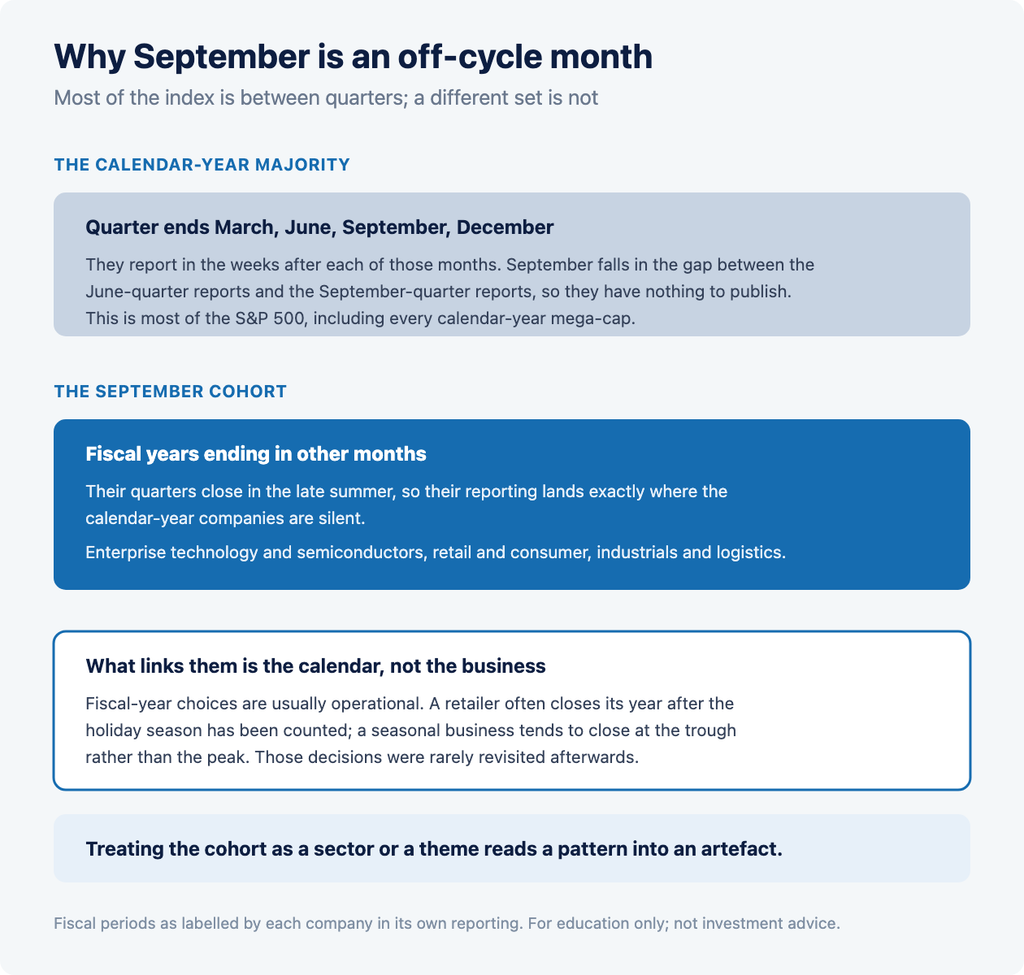
Because most large US companies align their fiscal year to the calendar year, and the companies reporting in September do not.
A company reporting for a quarter that ended on June 30 will typically report in July or early August. A company reporting for a quarter that ended on September 30 will report in October. September therefore falls in the gap for calendar-year reporters, which is most of the index.
The companies that do report in September have fiscal years ending in other months. Their quarters end in the late summer, so their reporting lands where the calendar-year companies have nothing to say.
What that means in practice
The month is thin at the top. No mega-cap technology company on a calendar year reports in September.
The names that do report carry more attention than usual. With fewer competing events, a September report occupies more of the available attention than the same report would in late October.
Coverage is less crowded. Fewer simultaneous releases means each one is examined more closely.
Why the fiscal years are set where they are
Fiscal-year choices are usually operational rather than financial. A retailer often ends its year after the holiday selling season has been counted and inventory has cleared, which pushes the year-end into the late winter. A company with a strongly seasonal business tends to end its year at the trough rather than the peak, so the annual accounts close on a quiet period rather than mid-cycle.
Those decisions were frequently made decades ago and are rarely revisited, because changing a fiscal year is disruptive and makes several years of comparisons awkward.
The consequence for a reader is that the September cohort has nothing conceptually in common. It is a group assembled by an accident of accounting calendars, and treating it as a sector or a theme reads a pattern into an artefact.
How do you read a fiscal quarter label?
Carefully, because “Q1 2027” in September is not a typographical error.
A fiscal year is the twelve-month accounting period a company chooses. It need not start in January. A company whose fiscal year begins in June will be in its first fiscal quarter during June, July and August, and will label the results it publishes in September as first-quarter results for a fiscal year named after the calendar year in which that fiscal year mostly falls or ends, depending on the company’s own convention.
| Company | Fiscal label for its September report | What that tells you |
| Broadcom | Q3 FY2026 | Third quarter of a fiscal year ending in the autumn |
| Adobe | Q3 FY2026 | Third quarter of a fiscal year ending late in the year |
| Oracle | Q1 FY2027 | First quarter of a fiscal year that has already begun |
| FedEx | Q1 FY2027 | First quarter of a fiscal year beginning in the summer |
| Micron Technology | Q4 FY2026 | Fourth quarter, so also the full-year close |
| Costco Wholesale | Q4 FY2026 | Fourth quarter, so also the full-year close |
| Nike | Q1 FY2027 | First quarter of a fiscal year beginning in the summer |
The comparison trap
Two companies both reporting in the same week can be reporting on periods that barely overlap. Comparing a “third quarter” from one against a “first quarter” from another, without checking what months each covers, compares different windows of time.
This is not a subtle distinction and it is routinely lost in coverage that groups September reporters together as though they were describing the same economy in the same weeks.
What is the difference between a confirmed date and a projected one?
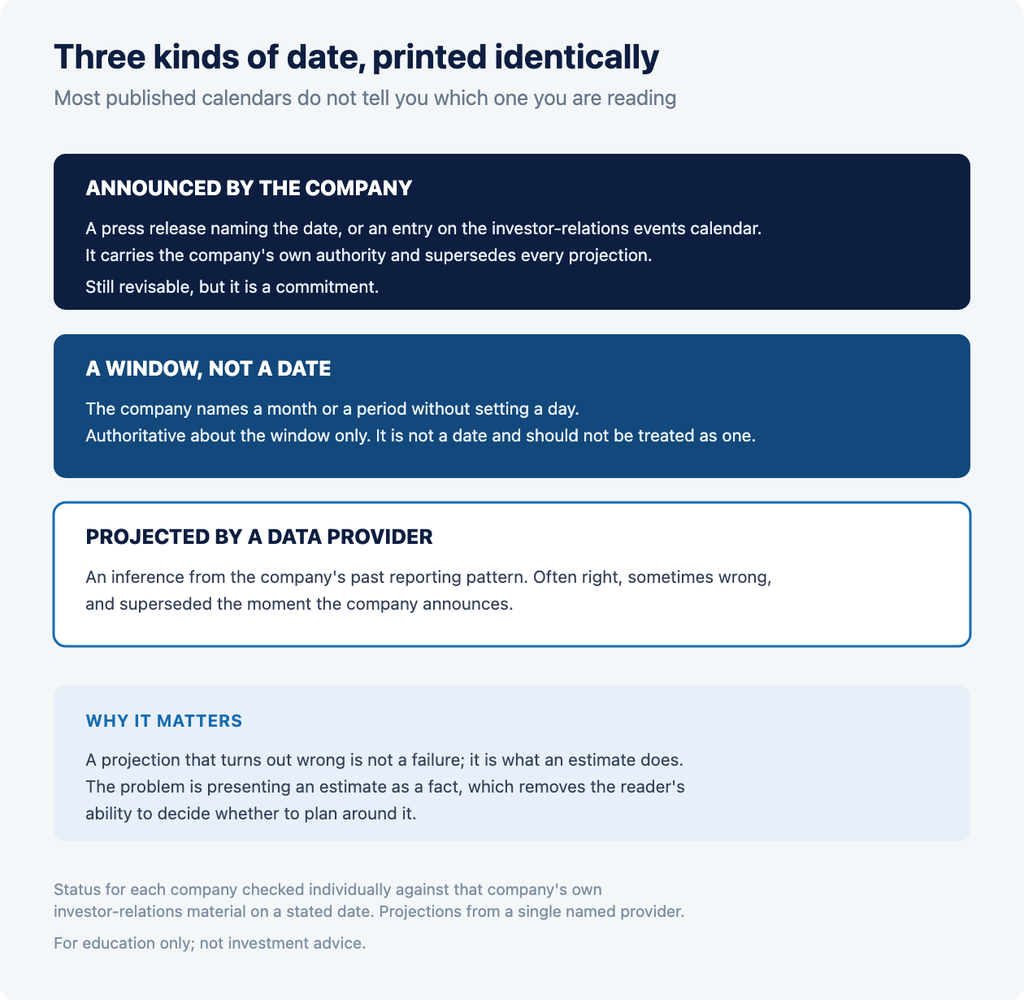
One is a statement by the company. The other is an inference by a third party. They look identical on a calendar page.
A confirmed date appears in a company press release or on its investor-relations events calendar. Broadcom, for example, announced on August 3 that it would report on September 2 after the close, with a conference call the same day.[^1] Adobe lists September 10 on its investor-relations upcoming-events section.[^2] Costco lists September 24 on its events page.[^3]
A projected date is produced by a data provider from a company’s past reporting pattern. It is an estimate. It is often right, and it can be wrong, and it is superseded the moment the company announces.
A window is a third thing. Oracle’s investor-relations FAQ states that first-quarter fiscal 2027 earnings “will be announced mid-September” without giving a date.[^4] That is a company statement, so it carries the company’s authority, but it is not a date. For context on how much notice the company gives: its previous first-quarter date was announced roughly a week before the release itself.[^5]
Why this distinction is worth a column
Because a reader who cannot tell the three apart cannot judge how much weight to place on any of them, and every published calendar this article checked presented them identically.
A projected date that turns out to be wrong is not a scandal. It is what an estimate does. The problem is presenting an estimate as a fact, which removes the reader’s ability to decide whether to plan around it.
How can a reader confirm a date themselves?
In two places, both free and both authoritative, and it takes about a minute per company.
The company’s investor-relations site. Every listed US company maintains one, and scheduled results appear either as a press release announcing the date or as an entry on an events calendar. This is the primary record. If the company has said it, it is here.
SEC EDGAR. Companies furnish results to the US Securities and Exchange Commission on Form 8-K, with the release attached as an exhibit. The filing appears at the moment it is made and is public immediately. EDGAR will not tell a reader a future date, but it settles what was actually reported and when.
What to look for, and what to distrust
| Where you found it | What it is | How much weight it carries |
| Company press release naming the date | A company statement | Highest. Still revisable, but it is a commitment. |
| Company investor-relations events calendar | A company statement | Highest, same as above. |
| Company statement giving a month or a window | A company statement, but not a date | Authoritative about the window only. |
| A data provider or aggregator | An inference from past pattern | Useful for planning; not a fact until the company confirms. |
| A date with no stated source | Unknown | None until traced. |
The last row is the common case. A great deal of published calendar information carries no indication of where the date came from, which makes it impossible to classify without doing the check yourself.
Which sectors cluster in September?
Three groups, and they are not the ones that dominate the calendar-year seasons.
Enterprise technology and semiconductors. Broadcom, Hewlett Packard Enterprise, Dell, Oracle, Micron and Jabil all report during the month. Several carry fiscal years ending in the late summer or autumn.
Retail and consumer. Costco, Kroger, Nike and Carnival report in September on fiscal years ending outside December.
Industrials and logistics. FedEx and Jabil report on periods ending in the late summer.
What links them is not sector but calendar. These are companies whose fiscal years were set for operational reasons, often decades ago, and the resulting reporting pattern is an accident of that choice rather than a statement about their businesses.
Does the reporting session change what a trader sees?
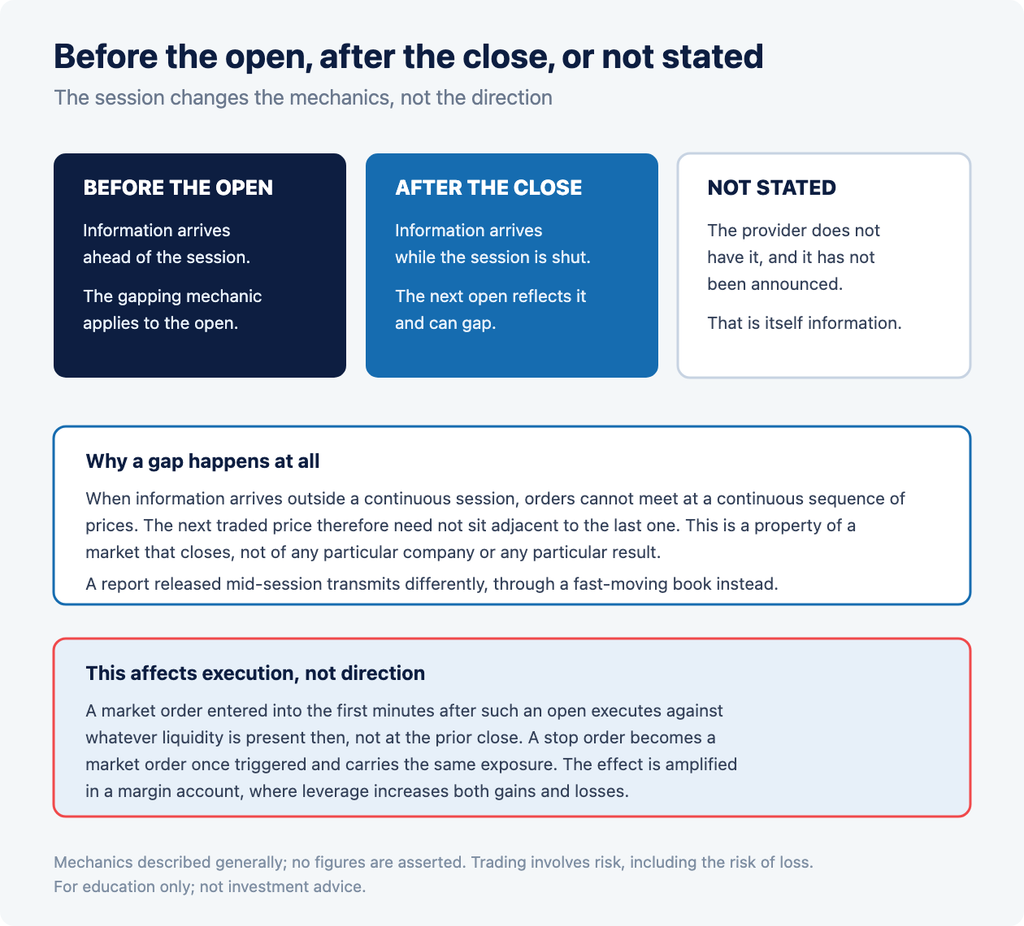
Yes, mechanically, and it is worth knowing which is which before the day.
After the close. The information arrives while the regular session is shut. Orders cannot meet at a continuous sequence of prices in that interval because no continuous session is running. When trading resumes, the opening price reflects information that arrived overnight and need not sit adjacent to the previous close. Broadcom, Adobe, Micron, Costco, Accenture, Lennar and Hewlett Packard Enterprise are listed as after-the-close reporters.
Before the open. The information arrives ahead of the session, and the same gapping mechanic applies to the open. Jabil and Carnival are listed as before-the-open reporters.
Not stated. Several rows in Table 1 carry no session. That is itself information: the provider does not have it, and it has not been announced.
What follows for order handling
The consequences concern execution rather than direction. A market order entered into the first minutes after an open following a scheduled release executes against whatever liquidity is present at that moment, not at the prior close. A stop order, which becomes a market order once triggered, carries the same exposure and does not guarantee a fill at the stop price.
Our articles on how earnings move stocks and on pre-market movers cover these mechanics in full.
What is a consensus estimate, and why do the figures differ between sources?
A consensus estimate is an average of individual forecasts that analysts have submitted to a data provider. It is not a company statement and not a regulatory filing.
Providers collect from different analyst panels, apply different rules about how stale a submission can be before it is dropped, and treat adjusted and reported earnings differently. Two providers publishing a consensus for the same company in the same week can print different figures, and neither is wrong.
This article cites a single named provider throughout, and says so, rather than referring to “the consensus” as though one authoritative number existed.[^6]
Guidance is a different number again
Several September reporters publish their own guidance for the quarter, and that guidance need not agree with any provider’s consensus. A company’s outlook and an analyst average are produced by different people, for different purposes, on different information.
The practical consequence is that a single reported figure can be described as beating one benchmark and missing another, in the same sentence, without either description being false. Which benchmark a commentator picks changes the headline without changing the number.
What is in a results release beyond the headline number?
More than most coverage uses, and the extra material is where the September reports differ most from one another.
The reported quarter. Revenue, earnings and the segment breakdown for the period that has closed. This is the part headlines quote.
The guidance. What the company expects for the next period, and sometimes for the full year. For several September reporters this is the more consequential number, because a result above an estimate alongside an outlook below expectations is a common combination.
The segment tables. A single total can be assembled from many combinations of a company’s segments, and those segments do not carry the same economics. Two quarters with identical headline revenue can carry different margin profiles.
Company-defined measures. Many releases carry figures the company defines itself, disclosed alongside the standard accounting lines. These are useful and specific to the issuer, but they are not standardised, and a figure carrying the same label at two companies may be measuring two different things.
The conference call. Frequently carries information the release does not, because commentary on pricing, demand and supply conditions is discussed rather than tabulated.
Why a beat does not guarantee a higher share price
Because the reported quarter is one component of several, and because the market’s positioning going in already reflects an expectation.
If participants were positioned for a result comfortably above consensus, a result modestly above it is not the same event. The reference point is the expectation, not the estimate printed on a screen. This is a general property of scheduled reporting rather than a claim about any company in Table 1.
When does the next full reporting season begin?
Mid-October, opening with the large US banks.
The calendar-year third quarter ends on September 30. Companies reporting on that basis publish through late October and into November, and the largest banks conventionally report first, in the second full week of October.
That means the September calendar in Table 1 is not a preview of the season. It is a separate set of companies on a separate schedule, and the two do not overlap.
What else is on the September macro calendar?
A dense run of scheduled US data, which shares the month with the reports in Table 1.
| Date | Time (ET) | Release | Agency |
| Sep 1 | 10:00 a.m. | Job Openings and Labor Turnover Survey, July | BLS |
| Sep 4 | 8:30 a.m. | Employment Situation, August | BLS |
| Sep 7 | – | Labor Day, US markets closed | – |
| Sep 10 | 8:30 a.m. | Producer Price Index, August | BLS |
| Sep 11 | 8:30 a.m. | Consumer Price Index, August | BLS |
| Sep 15-16 | – | FOMC meeting, with projections and press conference | Federal Reserve |
| Sep 16 | 8:30 a.m. | Advance Monthly Retail Trade, August | Census |
| Sep 29 | 10:00 a.m. | Job Openings and Labor Turnover Survey, August | BLS |
| Sep 30 | 8:30 a.m. | Personal Income and Outlays, August, containing the PCE price index | BEA |
| Sep 30 | 8:30 a.m. | Gross Domestic Product, third estimate, second quarter | BEA |
Two features of that calendar are easy to get wrong from memory.
The Producer Price Index precedes the Consumer Price Index this month, on the 10th and the 11th, reversing the more common order in which CPI publishes first. Anyone working from a remembered sequence rather than the published schedule may have those two the wrong way round.
September 16 carries two scheduled items in the same session, with retail sales at 8:30 a.m. and the Federal Reserve’s decision in the afternoon.
Why the two calendars are worth reading together
A company report and a scheduled data release are different kinds of event. A company release concerns one issuer and is published on that issuer’s own schedule. A macro release concerns the whole market and arrives at a published instant that is the same for everyone.
The practical point is only that both appear in the same weeks. A session can contain a scheduled data release in the morning and a company report after the close, and the calendar above is the record of which days those are.
How does the market commonly read an off-cycle month?
By treating each report as information about that company, and being cautious about anything broader.
Because September reporters cover periods that end at different times and serve different customers, the temptation to read one result as a signal about the wider economy or about another company is strong and weakly supported. These companies are grouped by the accident of their fiscal calendars, not by any shared exposure.
A single company’s result is information about that company. Whether it says anything about another is a judgement rather than a fact, and it is not a judgement this article makes.
Risks and limitations
Most dates here are not confirmed. Table 1’s status column is the most important thing on this page. Four of the fifteen rows are provider projections and one is a month-level window. Confirm any date you intend to plan around against the company’s own investor-relations site.
Dates change even after they are announced. A confirmed date is a commitment a company can revise, and revisions do happen, most often by a day or two rather than by weeks.
Consensus figures move. Estimates are revised continuously and most actively in the days before a report. The figures here are stamped to their retrieval date.
Provider figures are not interchangeable. This article names a single provider. Another may publish different numbers, and comparing across providers is not like-for-like.
The table is not exhaustive. The provider listed 193 September rows carrying revenue estimates. Table 1 shows a selection of the larger and more widely followed names and is not a complete calendar. A company absent from it is not thereby not reporting, and the full provider list is considerably longer than what is shown here.
Fiscal labels follow each company’s own convention. Table 2 reports the label each company uses. Conventions for naming a fiscal year differ between companies, so two firms with similar year-ends can label the same period differently.
Trading involves risk of loss. Volatility around a scheduled report can widen spreads and produce gaps between sessions. The effect is amplified in a margin account, where leverage increases both gains and losses relative to the capital committed. Margin requirements and account minimums are set out in the relevant account documentation.
Nothing here is investment advice. This article reports scheduled and projected dates and published estimates. It makes no recommendation about any security and expresses no view on any result.
A note on what this calendar is not
It is not a watchlist. The companies in Table 1 appear because their fiscal calendars place them in September, not because they have been selected on any other basis, and their presence here is not a view about any of them.
It is also not a ranking. The table is ordered by date, and the consensus figures are shown because they are the published benchmark each report will be measured against, not as a comparison between companies. Earnings per share is not comparable across companies with different share counts, and a larger figure is not a better one.
Frequently asked questions
Which companies report earnings in September 2026?
The larger names include Broadcom, Adobe, Oracle, FedEx, Micron, Costco, Accenture and Nike, alongside Dell, Hewlett Packard Enterprise, Kroger, Lennar, Jabil, Carnival and Medtronic. Most carry fiscal years that do not align to the calendar year, which is precisely why they report in this month.
Why do so few large companies report in September?
Most S&P 500 companies align their fiscal year to the calendar year, so they report in the weeks after each calendar quarter ends. September falls between those windows. The companies reporting in it have fiscal years ending in other months.
Are the September earnings dates confirmed?
Mostly not. At the time of writing, three of the headline names had announced their dates, one had published only a month-level window, and the rest were data-provider projections inferred from past reporting patterns. Confirm any date against the company’s investor-relations site.
What does fiscal Q1 2027 mean in September 2026?
It means the company’s fiscal year does not follow the calendar. Its fiscal 2027 has already begun, and the quarter being reported is the first of that fiscal year. The label describes the company’s own accounting calendar, not the calendar year.
When does the next full earnings season start?
Mid-October. The calendar-year third quarter ends on September 30, and companies reporting on that basis publish from the second full week of October into November, conventionally opening with the large US banks. The September names are a separate set on a separate schedule.
Does it matter whether a company reports before the open or after the close?
Mechanically yes. Information arriving outside a continuous session cannot be priced by orders meeting continuously, so the next traded price need not sit adjacent to the last one. That affects the cost and the certainty of getting filled rather than the direction of any instrument.
Sources
[^1]: Broadcom Inc., “Broadcom Inc. to Announce Third Quarter Fiscal Year 2026 Financial Results on Wednesday, September 2, 2026,” issued August 3, 2026, distributed via PR Newswire and carried on the company’s investor-relations financial news page. Retrieved August 19, 2026.
[^2]: Adobe Inc., investor-relations site, upcoming events, listing Thursday, September 10, 2026. Retrieved August 19, 2026.
[^3]: Costco Wholesale Corporation, investor-relations overview and events pages, upcoming events listing 09/24/2026. Retrieved August 19, 2026.
[^4]: Oracle Corporation, investor-relations frequently-asked-questions page: “Oracle’s First Quarter Fiscal Year 2027 earnings will be announced mid-September.” No specific date was stated. Retrieved August 19, 2026.
[^5]: Oracle Corporation, “Oracle Sets the Date for its First Quarter Fiscal Year 2026 Earnings Announcement,” issued September 2, 2025, announcing a release on September 9, 2025 after the close. Cited only as evidence of how much notice the company has previously given. Retrieved August 19, 2026.
[^6]: Finnhub, endpoint /calendar/earnings for the period September 1 to September 30, 2026, retrieved August 19, 2026. Source for the projected dates, the reporting sessions and the consensus figures in Table 1. This endpoint requires an API key and is not publicly reproducible from a bare link; the domain without a key returns an authentication error. API documentation: finnhub.io/docs/api. The raw response is retained.
This article is published by Capital Markets Elite Group (KY) Limited for informational and educational purposes only. It does not constitute investment advice, a recommendation, or an offer or solicitation to buy or sell any security or financial instrument. Trading involves risk, including the risk of loss. Past performance and historical data are not indicative of future results. Figures are stated as of the dates shown and may change. Readers should consider their own circumstances and consult a qualified professional where appropriate. See our full terms at /policies/.