

Q2 earnings season opens on Tuesday, July 14, 2026, when five major U.S. banks — JPMorgan, Goldman Sachs, Bank of America, Citigroup and Wells Fargo — report before the U.S. market open, with Morgan Stanley the next morning. The same day, the June Consumer Price Index lands at 8:30 a.m. ET, putting a market-wide macro release and the season’s first big earnings prints in a single session. This piece maps the calendar, the consensus estimates, and the mechanics of trading a before-the-open earnings wave. It is not a recommendation on any stock.
Data on this page is current as of July 9, 2026. Estimates are consensus figures that change as report dates approach; the calendar is re-verified before each season.
When do the big banks report? (the kickoff calendar)
Five of the largest U.S. banks by assets report before the U.S. market opens on Tuesday, July 14, 2026; Morgan Stanley follows Wednesday, July 15. The consensus earnings-per-share estimates below are from the Finnhub earnings calendar, retrieved July 9, 2026.
| Bank | Report date | Timing | Consensus EPS estimate |
| JPMorgan (JPM) | July 14, 2026 | Before open | $5.74 |
| Goldman Sachs (GS) | July 14, 2026 | Before open | $14.46 |
| Bank of America (BAC) | July 14, 2026 | Before open | $1.13 |
| Citigroup (C) | July 14, 2026 | Before open | $2.76 |
| Wells Fargo (WFC) | July 14, 2026 | Before open | $1.73 |
| Morgan Stanley (MS) | July 15, 2026 | Before open | $2.92 |
A consensus estimate is the market’s current expectation, not a target and not a forecast from this firm. What tends to move a stock on earnings day is the result relative to that expectation — the “surprise” — together with the guidance management gives, rather than the raw profit figure. Our explainer on how earnings move stocks covers the expected move, the surprise, and IV crush.
Why do banks open earnings season?
The large banks report in the first full week after quarter-end because their books close quickly and their reporting calendars have long sat at the front of the cycle. That timing has made bank results a customary starting point each season — the first broad read on the quarter before the rest of the market reports over the following weeks.
Their results also touch a wide cross-section of the economy. Lending margins, loan-loss provisions, trading desks, investment-banking fees and consumer-credit trends all show up in bank statements, so market participants often read them for signals that extend beyond the banks themselves. This is context, not a prediction: a strong or weak bank print does not determine how any other stock or the broader market trades.
For active traders, the practical point is concentration. Several closely watched reports arrive in the same pre-market window on July 14, which is why the session draws attention — and why the risks discussed below matter.
How have these banks surprised recently? (history, not a forecast)
In their most recently reported quarter (ending March 31, 2026), all six came in above the consensus EPS estimate, per Finnhub company-earnings data. This is historical data on prior quarters; it is not a prediction of the July results, and a past beat has not guaranteed a higher share price.
| Bank | Actual EPS | Consensus estimate | Surprise |
| JPMorgan (JPM) | $5.94 | $5.50 | +7.9% |
| Goldman Sachs (GS) | $17.55 | $16.99 | +3.3% |
| Bank of America (BAC) | $1.11 | $1.02 | +8.6% |
| Citigroup (C) | $3.06 | $2.70 | +13.3% |
| Wells Fargo (WFC) | $1.60 | $1.60 | +0.1% |
| Morgan Stanley (MS) | $3.43 | $3.09 | +10.9% |
Across the last four reported quarters, five of these six beat consensus in every quarter; Wells Fargo missed once, in the quarter ending December 31, 2025. The takeaway is not that banks “usually beat,” but that a surprise — in either direction — is only one input. Guidance, trading-revenue mix, net interest income and credit provisions can matter as much as the headline EPS, and a stock can fall on a beat if guidance or the composition of the result disappoints.
The July 14 collision: CPI at 8:30 and bank prints in one session
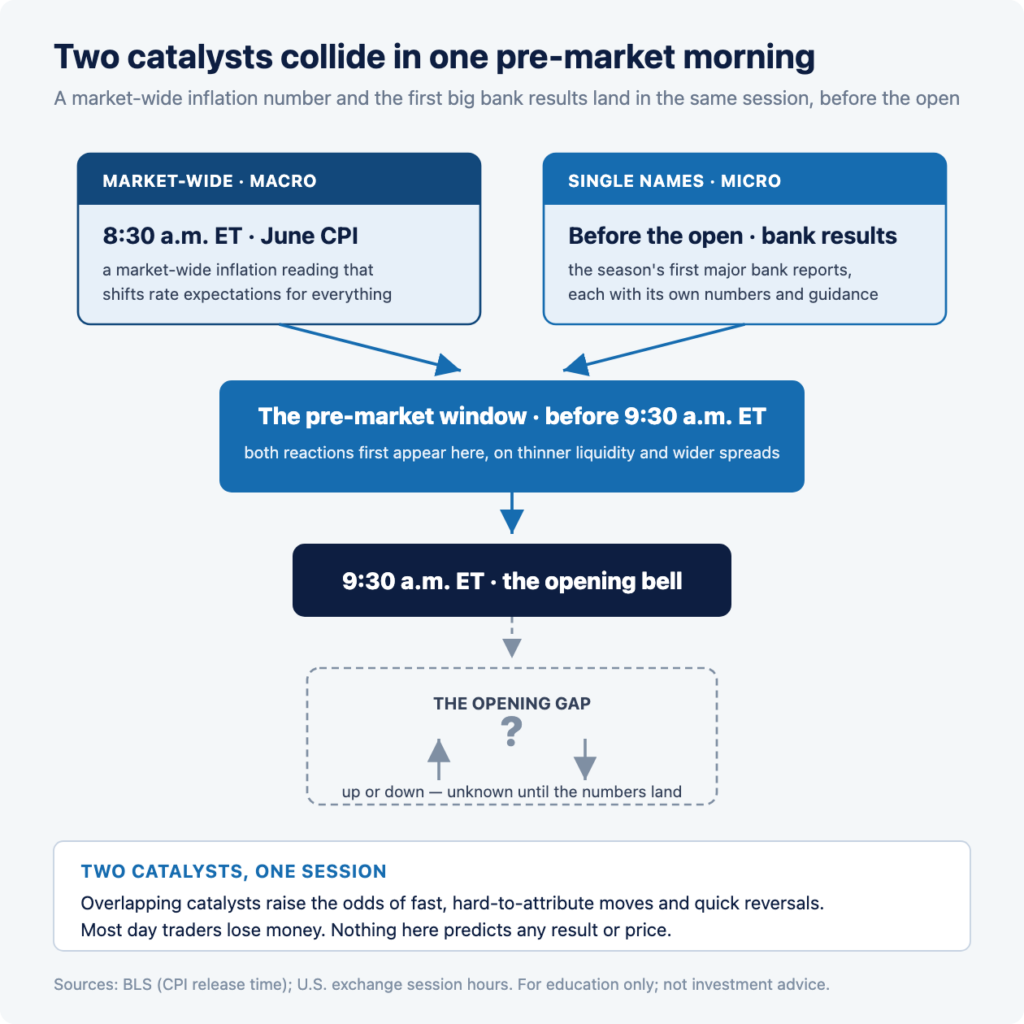
July 14 stacks two different kinds of catalyst into a single morning. The June Consumer Price Index is scheduled for 8:30 a.m. ET, per the U.S. Bureau of Labor Statistics release calendar — a market-wide macro number — while the bank results land in the same pre-market window as company-specific events. One release speaks to the whole market’s rate expectations; the others speak to individual names and their sectors.
For reference, the most recent CPI report (released June 10, 2026, covering May) showed headline CPI up 0.5% on the month and 4.2% over 12 months, with core CPI up 0.2% and 2.9%, per the BLS. That is the last print, not a forecast of the June number that arrives July 14. Our CPI report hub covers the release time, the schedule, and how the number moves markets.
Mechanically, both catalysts hit before the 9:30 a.m. ET open, so the first reactions show up in index futures and pre-market equity trading rather than the regular session. When a broad macro surprise and single-stock earnings move at the same time, the two can reinforce or offset each other, and it is not always clear in the moment which is driving a given price move. Pre-market liquidity is thinner and spreads are typically wider than in regular hours, so moves and reversals can be fast. Most day traders lose money, and a session with two overlapping catalysts does not change that.
What bank results tend to signal for the tape
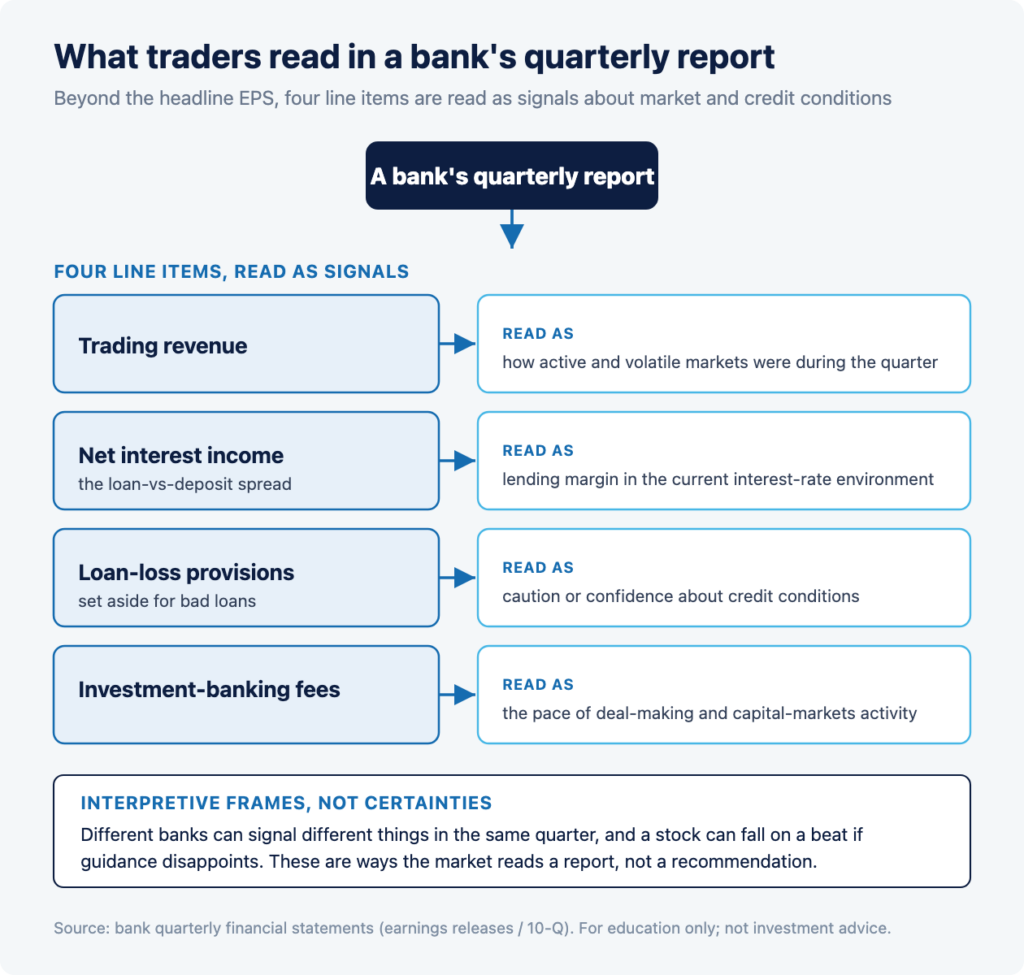
Bank statements contain several line items that market participants read for information beyond the banks themselves. Described factually, and with no implication about direction:
- Trading revenue — equities and fixed-income desk results reflect how active and volatile markets were during the quarter. Strong or weak trading revenue is often read as a gauge of market conditions generally.
- Net interest income (NII) — the difference between what a bank earns on loans and pays on deposits. NII and the guidance around it are read for signals about lending margins in the current rate environment.
- Loan-loss provisions / credit costs — the amounts banks set aside for expected loan losses. Rising provisions are often interpreted as caution about consumer and corporate credit; falling provisions, the opposite.
- Investment-banking and advisory fees — a read on deal-making and capital-markets activity.
Beyond headline EPS, four line items in a bank’s report are read as signals about market and credit conditions. These are interpretive frames, not certainties, and a stock can fall on a beat if guidance disappoints. Source: bank quarterly financial statements.
These are interpretive frames, not rules. Different banks can send different signals in the same quarter, and the market’s reaction depends on expectations that were already in place before the reports. Nothing here forecasts any of these figures or how a stock will react to them.
Before-the-open mechanics: gaps at the open, not after-hours moves
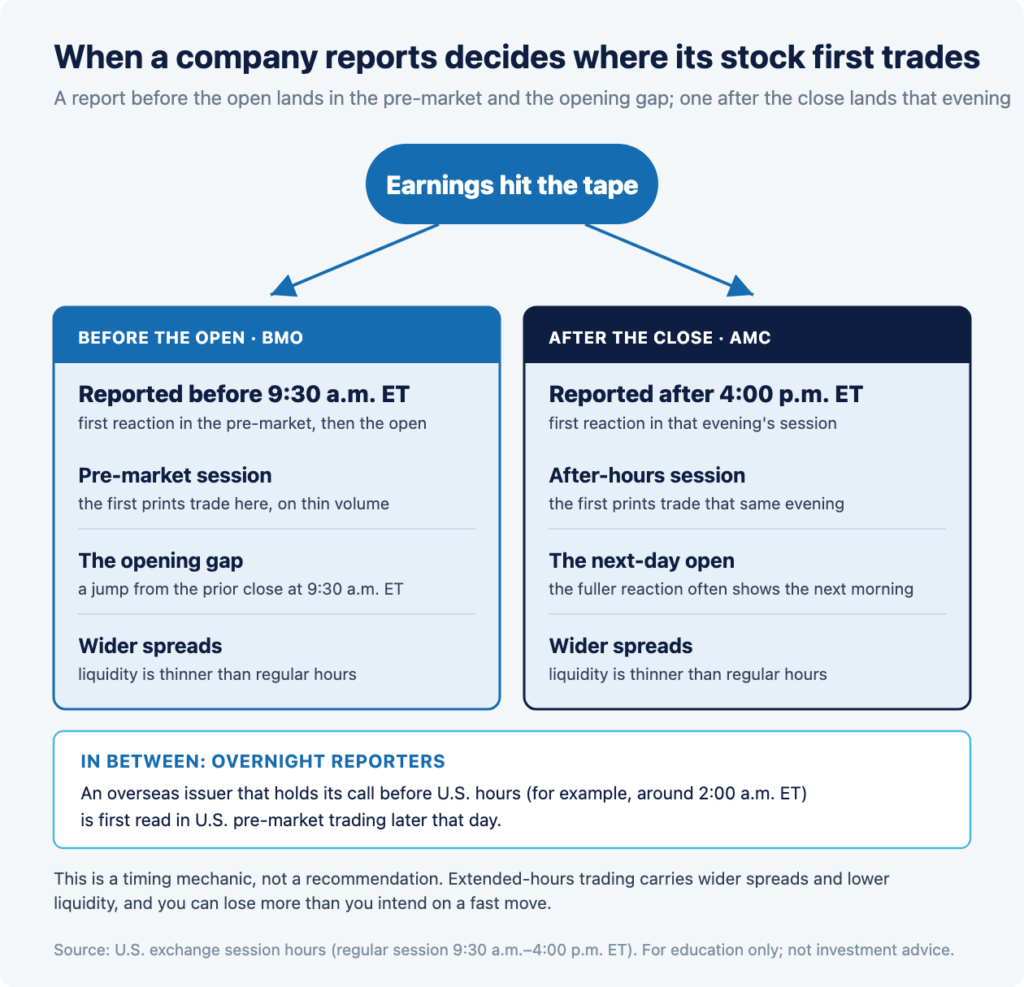
Most companies report either before the market opens (BMO) or after it closes (AMC). The banks on July 14 report before the open, which changes where and how the reaction appears. An after-the-close report is first traded in the after-hours session that evening; a before-the-open report is first traded in the pre-market session and then, more visibly, as a gap when regular trading begins at 9:30 a.m. ET.
A gap is simply an opening price that differs materially from the prior close, reflecting news that arrived while the regular session was shut. Because the banks report roughly an hour before the open — and CPI prints at 8:30 a.m. ET the same morning — the pre-market and the opening print on July 14 are where the session’s information gets absorbed. Our guide to pre-market movers explains how these gaps form and how to read them.
Trading these windows carries specific risks. Pre-market and opening liquidity is thinner, spreads are wider, and fast two-way moves are common as the market digests overlapping headlines. Reacting to a pre-market move requires extended-hours access, and extended-hours trading involves wider spreads and lower liquidity than regular trading; you can lose more than you intend on a fast move. Order type and risk controls matter more, not less, in these conditions.
The rest of kickoff week
The banks are the opening act; the back half of the week brings large-cap technology and semiconductor reports that the market watches closely. Dates below are from each company’s investor-relations calendar (ASML, TSMC) and the Finnhub earnings calendar (BLK, NFLX), retrieved July 9, 2026.
| Company | Report date | Timing | Consensus EPS estimate | Source |
| BlackRock (BLK) | July 15, 2026 | Before open | $12.67 | Finnhub |
| ASML (ASML) | July 15, 2026 | Pre-market release | — | ASML financial calendar |
| TSMC (TSM) | July 16, 2026 | Earnings call 2:00 a.m. ET | — | TSMC investor relations |
| Netflix (NFLX) | July 16, 2026 | After close | $0.80 | Finnhub |
TSMC holds its earnings conference before the U.S. session (2:00 a.m. ET on July 16), so the reaction in its U.S.-listed shares — an American Depositary Receipt — appears in U.S. pre-market and regular trading later that day rather than in a same-evening after-hours session. Netflix reports after the close on July 16, so its first reaction comes in that evening’s after-hours session. The mix of before-open, overnight and after-close reports across the week is a reminder that when a stock first trades on its news depends on when it reports.
What active traders typically watch
Factually, the items market participants tend to focus on during the kickoff week:
1. Each result versus consensus — for both EPS and revenue; the surprise, and the guidance alongside it, is what reactions key off, not the raw number.
2. The bank read-through — trading revenue, net interest income and credit provisions as context for market and credit conditions, understood as signals rather than certainties.
3. The CPI print on July 14 — a market-wide rate-expectations input arriving the same morning as the bank reports.
4. Pre-market and the opening gap — where before-the-open reports and the 8:30 a.m. macro number are first absorbed, in a thinner, wider-spread session.
5. Volatility around the 9:30 a.m. ET open — surprises tend to bring elevated volume and fast movement, conditions in which order type and risk controls matter.
Watching an event is not the same as trading it. These are the data points in the session, not a suggestion to take any position.
Risks
Trading around scheduled earnings and economic data involves substantial risk. Earnings are binary events: the outcome is unknown until the release, and prices can move sharply and unpredictably in either direction. On July 14 specifically, two overlapping catalysts — CPI at 8:30 a.m. ET and multiple bank reports before the open — raise the odds of fast, hard-to-attribute moves and quick reversals.
Pre-market and opening liquidity is thinner and spreads are wider than in regular hours, so slippage and gap risk are elevated. A positive earnings surprise does not guarantee a higher share price, and a negative one does not guarantee a lower price; the reaction depends on guidance and on what was already priced in. Most day traders lose money. Nothing on this page is a recommendation to trade any security, and nothing here predicts any result or price.
FAQ
When do bank earnings start in July 2026?
Five major U.S. banks — JPMorgan, Goldman Sachs, Bank of America, Citigroup and Wells Fargo — report before the U.S. market open on Tuesday, July 14, 2026, per the Finnhub earnings calendar (retrieved July 9, 2026). Morgan Stanley reports before the open on July 15.
What are the consensus EPS estimates for the big banks?
As of July 9, 2026 (Finnhub consensus): JPMorgan $5.74, Goldman Sachs $14.46, Bank of America $1.13, Citigroup $2.76, Wells Fargo $1.73, and Morgan Stanley $2.92. Consensus estimates are an average of analyst forecasts and change as report dates approach.
Is CPI released the same day as bank earnings?
Yes. The June Consumer Price Index is scheduled for 8:30 a.m. ET on July 14, 2026, per the BLS release calendar — the same morning the banks report before the open, putting a market-wide macro release and single-stock earnings in one session.
Do the banks report before or after the market opens?
Before the open. That means the first reaction appears in pre-market trading and in the opening gap at 9:30 a.m. ET, rather than in an after-hours session. Netflix, by contrast, reports after the close on July 16.
What else reports during kickoff week?
Notable reports include BlackRock and ASML on July 15, and TSMC and Netflix on July 16, per company investor-relations calendars and Finnhub (retrieved July 9, 2026). TSMC’s call is at 2:00 a.m. ET, so its U.S.-listed shares react in U.S. pre-market and regular hours that day.
Does a bank beating estimates mean its stock will rise?
No. In the quarter ending March 31, 2026, all six banks beat consensus EPS (Finnhub), but a beat has not guaranteed a higher share price. Reactions depend on guidance, trading-revenue mix, net interest income, credit provisions and what the market already expected.
Disclosures: Trading involves substantial risk and is not suitable for every investor. Capital is at risk and most day traders lose money. Leverage, where offered, amplifies both gains and losses, and you can lose more than you deposit. Client accounts are not SIPC or FSCS insured. This content is provided for information and education only. It is not investment advice or a recommendation of any security, and it does not predict any company’s results, any stock’s price, or any market. Earnings dates and consensus estimates are sourced from Finnhub and company investor-relations calendars, the CPI release time is from the U.S. Bureau of Labor Statistics, and all figures are dated as above. See our full disclosures and policies.
<!– CMS: NewsArticle schema — headline, datePublished (2026-07-XX), dateModified (update each refresh), publisher=CMEG, about=”Q2 2026 bank earnings season”. FAQPage schema on the FAQ block. Internal links to wire at publish: “how earnings move stocks” → How Earnings Move Stocks; “CPI report hub” → CPI Report hub; “pre-market movers” → Premarket Movers; disclosures → /policies/. –>
<!– PUBLISH-DAY REFRESH BOX (5 min, no prose re-review needed):
1. Re-pull the Finnhub earnings calendar for 2026-07-13..2026-07-17 and confirm/refresh the two calendar tables (Kickoff calendar + Rest of the week). Estimates drift; dates can move.
2. Confirm June CPI is still 2026-07-14 08:30 ET on the BLS schedule (bls.gov/schedule/news_release/cpi.htm).
3. Update the “Data on this page is current as of …” stamp to the publish date.
4. If published AFTER 2026-07-14, convert the direct answer + July-14-collision section to past tense (“reported”/”landed”) and add a one-line “what the openers showed” note; the surprise-history table, the three infographics, and the mechanics sections stay evergreen.
–>