

Taiwan Semiconductor Manufacturing Company (TSMC) holds its second-quarter 2026 earnings conference on Thursday, July 16, 2026, at 2:00 a.m. ET (2:00 p.m. Taiwan time), before the U.S. market opens. Consensus expects EPS of about NT$24.34 per ordinary share (Finnhub). Because TSMC manufactures the advanced chips that companies such as Nvidia and AMD design, its results and capital-spending guidance are read as a signal for the wider AI-chip trade. This is factual reporting, not a recommendation on any stock.
Data on this page is current as of July 10, 2026. Estimates are consensus figures that change as the report date approaches; this hub is re-verified and refreshed each quarter.
When does TSMC report Q2 2026 earnings?
TSMC holds its second-quarter 2026 earnings conference on Thursday, July 16, 2026, at 2:00 a.m. ET, per the company’s investor-relations calendar. Because that is the middle of the afternoon in Taiwan and the small hours in the U.S., the results land before the U.S. market opens, so the first reaction in TSMC’s U.S.-listed shares shows up in U.S. pre-market and regular trading later that day.
| Item | Detail |
| Report date | Thursday, July 16, 2026 |
| Earnings conference | 2:00 a.m. ET (2:00 p.m. Taiwan time) |
| U.S. reaction window | Pre-market and regular session, July 16 |
| Consensus EPS estimate | About NT$24.34 per ordinary share (Finnhub) |
| Consensus revenue estimate | About NT$1.28 trillion (Finnhub) |
A consensus estimate is the market’s average expectation, not a target and not a forecast from this firm. What tends to move a stock on earnings day is the result relative to that expectation — the surprise — together with the guidance management gives, rather than the raw number. Our explainer on how earnings move stocks covers the expected move, the surprise, and IV crush.
Why is TSMC watched as an AI bellwether?
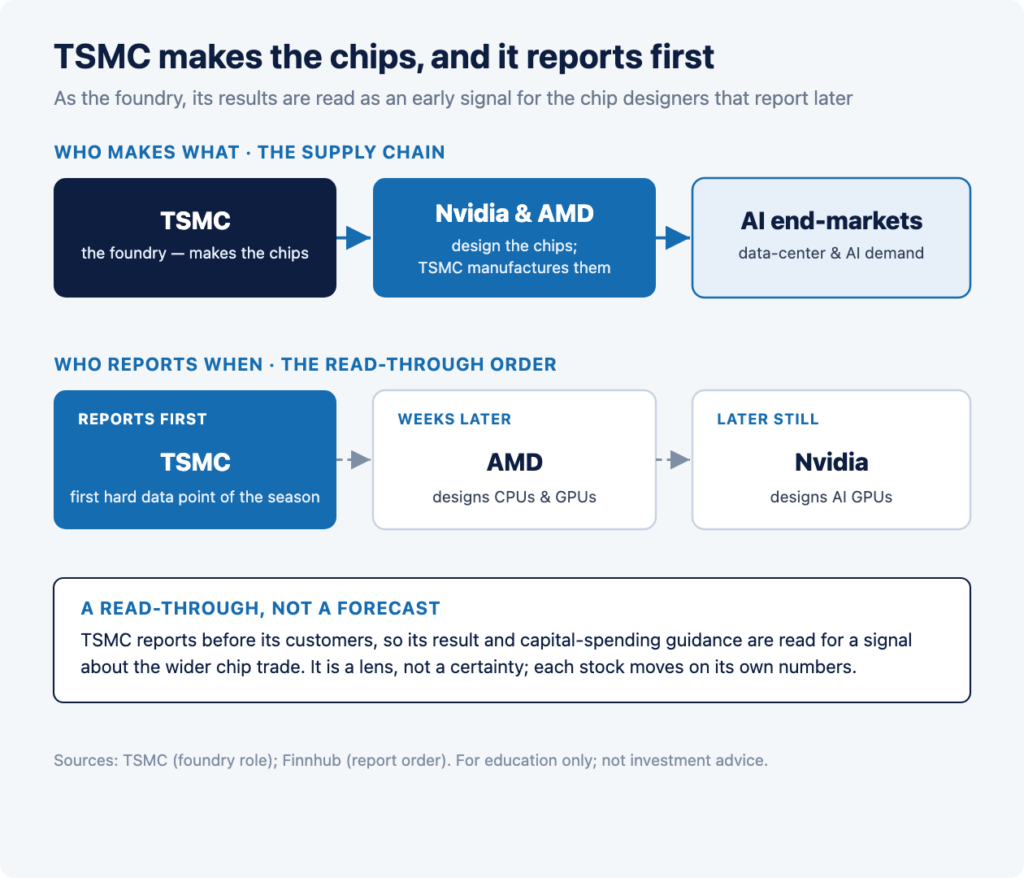
TSMC is a foundry: it manufactures chips that other companies design. It is the world’s largest dedicated contract chipmaker, and it fabricates the advanced processors at the center of the AI build-out, including the GPUs that companies such as Nvidia and AMD design but do not manufacture themselves. That position is why its results are often described as a read on the whole AI-chip supply chain.
The logic is a supply-chain one, stated factually. Nvidia and AMD sell chips; TSMC makes them. So TSMC’s revenue, its utilization, and above all its capital-spending (capex) guidance — how much it plans to invest in new capacity — are read as an early, physical signal of demand across the complex, ahead of the chip designers’ own reports. If a foundry is expanding capacity, it is doing so against orders it already sees.
This is context, not a prediction. A signal is not a certainty: TSMC’s guidance reflects its own order book and outlook, and how any other company’s stock trades depends on that company’s own results and on what the market already expected. Nothing here forecasts TSMC’s numbers or any stock’s reaction.
What TSMC’s results signal for Nvidia and AMD
Because TSMC reports before its largest customers, traders read its results and guidance for a “read-through” to the chip designers that report later in the season. The mechanism is straightforward: strong or weak foundry demand and capex plans speak to the same end-markets that Nvidia and AMD serve. But a read-through is a lens, not a forecast — the designers’ stocks move on their own numbers when they report.
| Company | Supply-chain role | Next 2026 report |
| TSMC (TSM) | Foundry — manufactures the chips | July 16, 2026 |
| AMD (AMD) | Designs CPUs and GPUs | August 4, 2026 (after close) |
| Nvidia (NVDA) | Designs AI GPUs | August 25, 2026 (after close) |
The AI-chip read-through calendar: TSMC reports first, the chip designers follow. Source: Finnhub earnings calendar, retrieved July 10, 2026. Dates can move; re-verify before relying on them.
The order of the calendar is the point. TSMC on July 16 comes weeks before AMD in early August and Nvidia in late August, so its report is the first hard data point of the season for the AI-chip theme. Traders watch whether its guidance is consistent with, or at odds with, the expectations already built into the designers’ shares. Whether those shares actually move on TSMC’s print, and in which direction, is not something this article predicts.
The chip complex heading into the print
TSMC reports into a semiconductor sector that has been among the most closely watched trades of 2026, driven by demand tied to artificial intelligence; our AI Stocks 2026 overview maps that broader theme. That attention cuts both ways: the same names have seen sharp moves in both directions this year, which is a reminder that a widely watched, heavily owned sector can be volatile around a major catalyst.
For a trader, the practical consequence is that TSMC’s report is a scheduled, known event in a sector where positioning is often crowded. Crowded positioning can amplify a move when a result differs from expectations, in either direction. That is a description of how such events can behave, not a prediction that this one will, and not a view on any stock.
What is an ADR, and how do U.S. traders trade TSM?
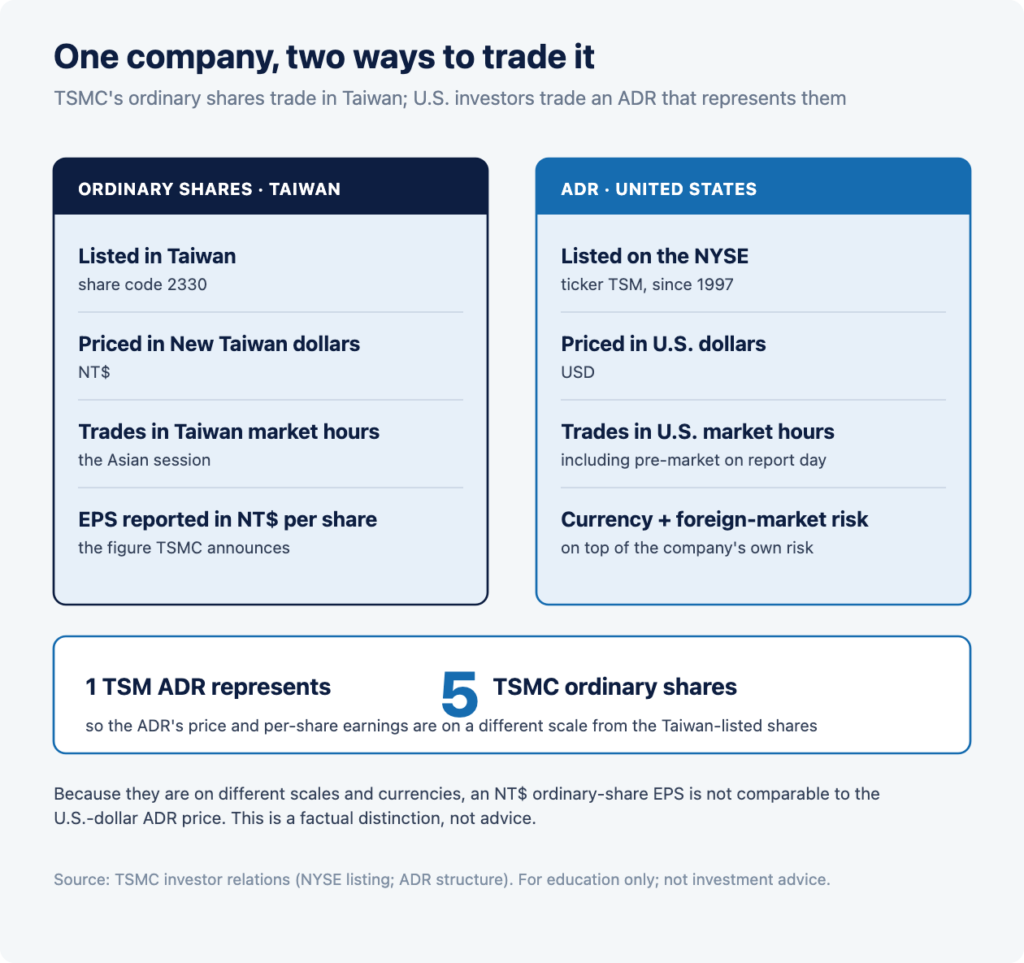
TSMC is a Taiwanese company; its ordinary shares are listed in Taiwan under the code 2330. U.S. investors trade it through an American Depositary Receipt (ADR) — a certificate, listed on the New York Stock Exchange under the ticker TSM, that represents shares of a foreign company and trades in U.S. dollars during U.S. hours. TSMC’s ADRs have traded on the NYSE since 1997.
A few mechanics matter for reading the numbers:
- The ratio. Each TSM ADR represents five TSMC ordinary shares. So the ADR’s price and its per-share earnings are on a different scale from the Taiwan-listed shares.
- The currency. TSMC reports its financial results in New Taiwan dollars (NT$). The EPS and revenue estimates above are in NT$, per ordinary share; the ADR’s figures are in U.S. dollars. Comparing an NT$ ordinary-share EPS directly with a U.S.-dollar ADR price is an apples-to-oranges error worth avoiding.
- The hours. Because the Taiwan market and TSMC’s earnings call run on Taiwan time, news can arrive while U.S. regular trading is closed. The TSM ADR then reacts in U.S. pre-market and at the open. Our guide to pre-market movers explains how those gaps form.
- Extra risks. An ADR carries currency risk (the NT$/USD exchange rate affects it) and foreign-market risk on top of the company’s own risks.
Expected move and IV crush around an earnings report
Ahead of a scheduled earnings report, the options market prices an expected move — an approximate range, implied by option prices, for how much the stock might move on the result. It is a measure of uncertainty, not a direction: a wide expected move says the market sees a bigger potential swing, not which way.
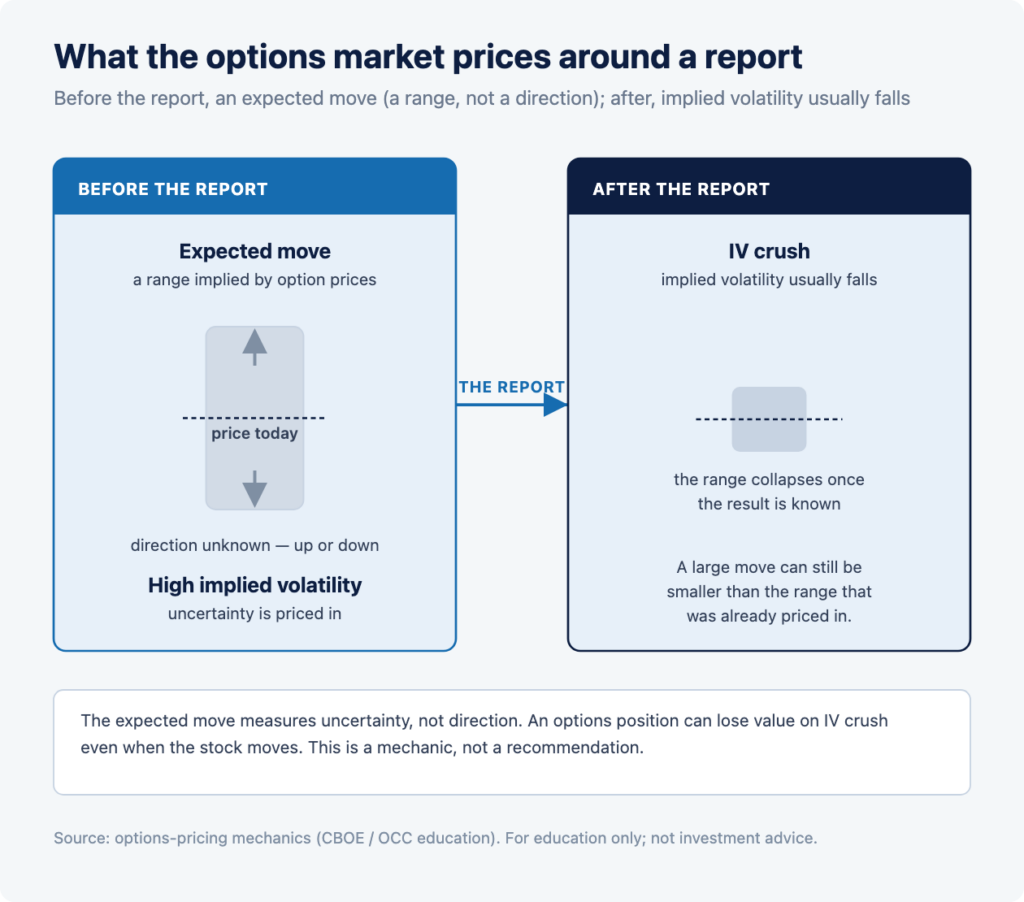
After the report, implied volatility usually falls sharply once the uncertainty is resolved — the effect known as IV crush. A trader can be right that a move will be large and still lose on an options position if the move is smaller than the expected move already priced in. For a foreign name traded as an ADR, the reaction can also be spread across the overnight and pre-market windows rather than a single regular-hours session. Our explainer on how earnings move stocks works through expected moves, IV crush, and overnight gaps in detail. For an illustration only, if options implied an expected move of, e.g., a mid-single-digit percentage, that would describe the range the market is pricing — not a prediction that the stock will move that much or in any direction.
How has TSMC surprised in recent quarters?
In each of its last four reported quarters, TSMC’s actual EPS came in above the consensus estimate, per Finnhub company-earnings data. This is historical data on prior quarters; it is not a prediction of the July result, and a past beat has not guaranteed the ADR rose.
| Quarter | Actual EPS (NT$) | Consensus estimate (NT$) | Surprise |
| Q1 2026 (ended Mar 31) | 22.08 | 21.14 | +4.4% |
| Q4 2025 (ended Dec 31) | 19.50 | 18.54 | +5.2% |
| Q3 2025 (ended Sep 30) | 17.44 | 16.15 | +8.0% |
| Q2 2025 (ended Jun 30) | 15.36 | 14.82 | +3.7% |
The pattern to take from this is not that TSMC “usually beats,” but that the surprise is only one input. A stock, or an ADR, can fall on a beat if guidance or the composition of the result disappoints, and the reaction always depends on what the market had already priced in. Four beats in a row is history, not a forecast.
What active traders typically watch
Factually, the items market participants tend to focus on around a TSMC report:
1. The result versus consensus — for both EPS and revenue; the surprise, and the guidance alongside it, is what reactions key off, not the raw number.
2. Capex and capacity guidance — the physical signal of demand that the market reads through to the wider AI-chip complex.
3. The read-through to AMD and Nvidia — as context for the reports that follow in August, understood as a lens rather than a certainty.
4. The ADR in U.S. pre-market — where a Taiwan-time report is first absorbed, in a thinner, wider-spread session.
5. The expected move and IV — what the options market is pricing as a range, and the IV crush that typically follows the report.
Watching an event is not the same as trading it. These are the data points around the report, not a suggestion to take any position.
Risks
Trading around scheduled earnings involves substantial risk. Earnings are binary events: the outcome is unknown until the release, and prices can move sharply and unpredictably in either direction. A positive surprise does not guarantee a higher price, and a negative one does not guarantee a lower price; the reaction depends on guidance and on what was already priced in.
For a foreign name traded as an ADR, additional factors apply: the reaction can arrive overnight and in pre-market, where liquidity is thinner and spreads are wider than in regular hours, and the ADR also carries currency and foreign-market risk. Reacting in these windows requires extended-hours access, which involves wider spreads and lower liquidity; you can lose more than you intend on a fast move. Most day traders lose money. Nothing on this page is a recommendation to trade any security, and nothing here predicts any result or price.
FAQ
When does TSMC report earnings?
TSMC holds its second-quarter 2026 earnings conference on Thursday, July 16, 2026, at 2:00 a.m. ET (2:00 p.m. Taiwan time), per its investor-relations calendar. Because that is before the U.S. open, the TSM ADR first reacts in U.S. pre-market and regular trading that day.
What is the consensus estimate for TSMC’s Q2 2026 earnings?
Consensus is for EPS of about NT$24.34 per ordinary share and revenue of about NT$1.28 trillion, per Finnhub (retrieved July 10, 2026). TSMC reports in New Taiwan dollars; the figures for the U.S.-listed ADR are in U.S. dollars and are on a different scale.
Why is TSMC called an AI bellwether?
TSMC manufactures the advanced chips that companies such as Nvidia and AMD design, so its results, utilization and capital-spending guidance are read as an early signal of demand across the AI-chip supply chain — a read-through, not a forecast of any other company’s results.
How do U.S. traders buy TSMC?
Through its American Depositary Receipt (ADR), listed on the NYSE under the ticker TSM and traded in U.S. dollars. Each TSM ADR represents five TSMC ordinary shares. An ADR carries currency and foreign-market risk in addition to the company’s own risks.
Does TSMC report before or after the U.S. market?
Its earnings conference is at 2:00 a.m. ET, before the U.S. open, so the TSM ADR reacts in U.S. pre-market and the regular session on July 16 — not in a same-evening after-hours session like a typical U.S. after-the-close reporter.
Does a TSMC beat mean the stock will rise?
No. TSMC beat consensus EPS in each of its last four reported quarters (Finnhub), but a beat has not guaranteed the stock or ADR rose. Reactions depend on guidance, capex, the read-through to the sector, and what the market already expected.
Disclosures: Trading involves substantial risk and is not suitable for every investor. Capital is at risk and most day traders lose money. Leverage, where offered, amplifies both gains and losses, and you can lose more than you deposit. American Depositary Receipts carry currency and foreign-market risk in addition to the underlying company’s risks. Client accounts are not SIPC or FSCS insured. This content is provided for information and education only. It is not investment advice or a recommendation of any security, and it does not predict any company’s results, any stock’s price, or any market. Earnings dates and consensus estimates are sourced from Finnhub and TSMC’s investor-relations calendar, TSMC’s reported EPS figures are from the company’s financial statements, and all figures are dated as above. See our full disclosures and policies.
<!– CMS: NewsArticle schema — headline, datePublished (2026-07-XX), dateModified (update each refresh), publisher=CMEG, about=”TSMC Q2 2026 earnings”. FAQPage schema on the FAQ block. Internal links to wire at publish: “how earnings move stocks” → How Earnings Move Stocks; “pre-market movers” → Premarket Movers; “AI Stocks 2026” → AI Stocks 2026 pillar (add a contextual link in the read-through or bellwether section at publish); disclosures → /policies/. –>
<!– PUBLISH-DAY REFRESH BOX (5 min, no prose re-review needed):
1. Re-pull the Finnhub TSM consensus (EPS/revenue) and the AMD/NVDA read-through dates; refresh both tables. Estimates and dates drift.
2. Confirm the TSMC Q2 2026 earnings-call date/time on investor.tsmc.com (financial calendar).
3. Update the “Data on this page is current as of …” stamp to the publish date.
4. If published AFTER 2026-07-16, convert to the post-report hub: change the direct answer and “When” section to past tense, add a one-line “what TSMC reported vs consensus” note (actual EPS + revenue in NT$, sourced), point the read-through forward to AMD (Aug 4) and Nvidia (Aug 25); the ADR, expected-move, surprise-history and risk sections stay evergreen.
–>