
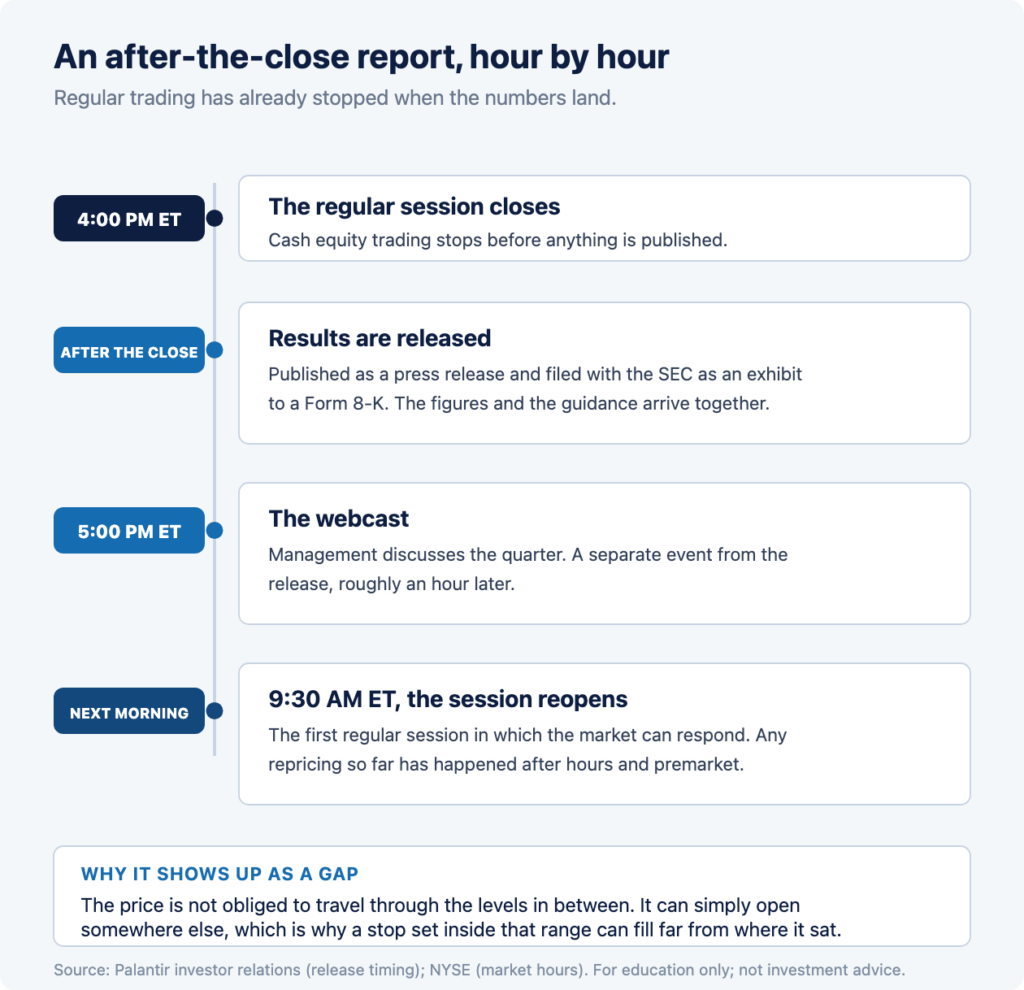
Palantir Technologies (NASDAQ: PLTR) will release its second-quarter 2026 results on Monday, August 3, 2026, following the close of U.S. markets, with a webcast at 5:00 p.m. ET, according to the company’s own announcement. [1] Published analyst estimates for the quarter sit at roughly $0.33 to $0.354 per share depending on the data provider, and the company’s own revenue guidance for the quarter is $1.797 billion to $1.801 billion. [2] [3]
Data on this page is current as of July 17, 2026. It is updated after each quarterly report. This content is for information and education only and is not investment advice.
When does Palantir report earnings?
Palantir announced on July 13, 2026 that results for its second quarter, which ended June 30, 2026, will be released on Monday, August 3, 2026, following the close of U.S. markets. The company will host a webcast to discuss the results at 5:00 p.m. ET. [1]
The date came from the company, not an aggregator
This distinction matters more than it sounds. Third-party earnings calendars are convenient, but they are secondary sources, and they do not always agree with each other or with the issuer. At the time of writing, several widely used data providers listed Palantir’s Q2 date as August 2, 2026, while the company’s own press release says August 3. [1] One of them contradicted itself on the same page, showing one date in its table and the other in its page metadata. August 2, 2026 is a Sunday. The issuer’s announcement is the authority. Any date on this page traces to Palantir’s investor-relations release, and it should be re-checked there before it is relied on.
After the close, not during the session
Because the release lands after the 4:00 p.m. ET close, no regular-session trading happens on the numbers on the day they are published. The first regular session in which the market can respond is the following morning, opening at 9:30 a.m. ET. [4] Any price discovery between those two points happens in the after-hours and premarket sessions, where liquidity is thinner and spreads are typically wider than in regular hours.
What is actually released, and what the webcast adds
Two separate things arrive, and they are not simultaneous. The results themselves are published after the close as a press release, filed with the SEC as an exhibit to a Form 8-K. [5] The webcast follows at 5:00 p.m. ET, in which management discusses the quarter. [1]
A detail specific to Palantir
Palantir also runs a shareholder question platform for its earnings calls: shareholders can submit and vote on questions ahead of the call, and the company directs them to a third-party platform to do so. [1] That is a factual feature of how this particular company runs its calls, and it is unusual enough to be worth knowing about if the call itself is being followed.
What is a consensus estimate, and why do published numbers differ?
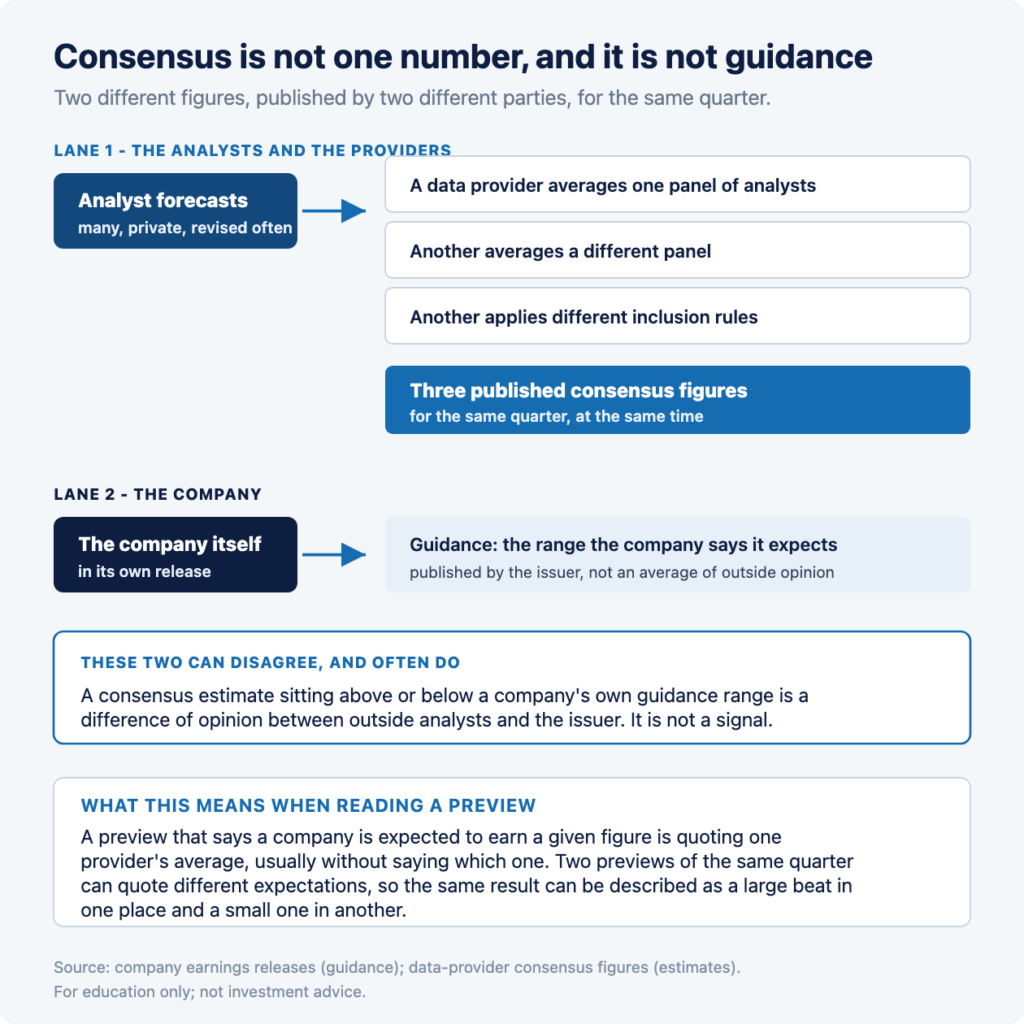
A consensus estimate is not an official figure. It is an average of forecasts made by the analysts who cover the company, assembled by a data provider. Different providers survey different analyst panels, apply different rules about which estimates to include, and update on different schedules. The result is that the same quarter has several different published “consensus” numbers at the same time.
The spread is real and checkable
For Palantir’s second quarter of 2026, published estimates retrieved on July 17, 2026 ranged from about $0.33 to $0.354 per share across data providers. [3] This article uses Finnhub’s figure of about $0.354 as its named source, and states the range rather than presenting any single number as “the” consensus. This is not a criticism of any provider. It is how the number is constructed.
Why this matters when reading a preview
A preview that says a company is “expected to earn $X” is quoting one provider’s average, usually without saying which. Two previews of the same quarter can therefore quote different expectations, and a print can be described as a “beat” against one and a smaller beat against another. Knowing which figure is being used, and that it is an average of private forecasts rather than an official number, is the difference between reading the coverage and reading the quarter.
Consensus is not guidance
These two are routinely conflated, and they come from entirely different parties.
- Guidance is published by the company. In its Q1 2026 release, Palantir stated that for Q2 2026 it expected revenue of between $1.797 billion and $1.801 billion, and adjusted income from operations of between $1.063 billion and $1.067 billion. [2]
- Consensus is published by data providers, averaging outside analysts. Finnhub’s revenue estimate for the same quarter is approximately $1.840 billion. [3]
These two numbers do not currently match
Finnhub’s revenue estimate sits above the top of the company’s own guidance range for the quarter. [2] [3] That is a factual observation about two specific published figures, and it is stated here as such.
The qualification from the section above applies to this comparison too, and it matters: this sets one named provider’s estimate against the company’s guidance. Another provider’s revenue estimate sits somewhere else, and at least one published figure retrieved on the same date sat below the guidance range rather than above it. So the honest reading is not “analysts expect more than the company does.” It is that guidance and consensus are separate quantities, published by different parties, that need not agree and frequently do not. It is not a prediction that either will prove correct, and it does not indicate what the company will report or how the market will respond.
| Measure | Published by | Figure for Q2 2026 |
| Revenue guidance | Palantir (the company) | $1.797bn to $1.801bn |
| Revenue estimate | Finnhub (consensus of analysts) | approx. $1.840bn |
| Adjusted income from operations guidance | Palantir (the company) | $1.063bn to $1.067bn |
| EPS estimate | data providers (range observed) | approx. $0.33 to $0.354 |
GAAP or adjusted? The EPS in a preview is usually not the GAAP number
This catches people out, and it is worth being precise about. Companies report earnings per share on two bases: GAAP, which follows standard accounting rules, and an adjusted or non-GAAP basis, which excludes items the company considers non-representative, most commonly stock-based compensation.
Palantir’s last quarter shows the gap
In its Q1 2026 report, Palantir stated GAAP diluted earnings per share of $0.34 and adjusted diluted earnings per share of $0.33. [2] Two different figures, for the same quarter, both published by the company in the same release.
Which one the “beat” is measured against
Analyst consensus for a company like this is generally compiled on the adjusted basis, so the surprise figures reported in earnings coverage compare the adjusted number to an adjusted estimate. That is what the surprise history further down this page reflects. A reader comparing a GAAP EPS figure to a consensus estimate is comparing two different things and will reach the wrong conclusion about whether the quarter beat.
What did Palantir’s last reported quarter show?
The most recent reported quarter is Q1 2026, released May 4, 2026. Per the company’s own release: [2]
- Revenue: $1.633 billion, up 85% year over year.
- U.S. revenue: up 104% year over year; U.S. commercial revenue: up 133% year over year.
- GAAP net income: $871 million.
- GAAP diluted EPS: $0.34; adjusted diluted EPS: $0.33.
- Adjusted operating margin: 60%.
- Full-year 2026 revenue guidance: $7.650 billion to $7.662 billion.
These are the company’s reported figures for a quarter that has already closed. They describe what happened, not what will happen, and past growth rates are not an indication of future results.
What is the Rule of 40, and why does Palantir publish it?
One figure in that list is not a standard accounting measure at all, and it is worth explaining because Palantir puts it in its own release and most previews skip past it. In the Q1 2026 report the company stated a Rule of 40 score of 145%. [2]
What the metric is
The Rule of 40 is a convention used in the software industry rather than a defined accounting term. It adds a company’s revenue growth rate to its profit margin and reads the total as a single number. The convention holds that a combined score of 40 or above indicates a business balancing growth against profitability; below 40 suggests one is being traded away for the other.
Palantir states its own formula in the release itself: the term “refers to the sum of our revenue growth rate year-over-year and our adjusted operating margin.” [2] That is checkable arithmetic against the same release: revenue growth of 85% plus an adjusted operating margin of 60% gives the 145% score the company published. Because it is a convention rather than a rule in any formal sense, no regulator or standards body defines it, and a company that publishes it chooses which margin measure goes into it, which is why a score from one company is not necessarily built the same way as a score from another.
Why it appears in a software company’s release
A company growing quickly while spending heavily can show strong revenue growth and thin margins; a mature one can show the reverse. The Rule of 40 is an attempt to describe both in one figure so the two are not read in isolation. When a company publishes the score itself, as Palantir does, it is presenting its own calculation using its own choice of inputs, which is a different thing from an independently computed measure.
How to treat the number
As a company-published figure, sourced to the company, describing a quarter that has already closed. It carries no information about the next quarter, and a score in any range is not an indication that a security will do anything. It is included on this page because it appears in the release a reader will encounter, and an unexplained metric is worse than no metric.
When do Palantir’s quarters end, and how long until they report?
Palantir reports on a calendar fiscal year, so its quarters end on March 31, June 30, September 30 and December 31. [2] The report follows the quarter’s end by roughly four to five weeks.
The current example
The second quarter of 2026 ended June 30, 2026, and the results are scheduled for August 3, 2026, about five weeks later. [1] That gap is normal: the company has to close its books, have the figures reviewed, and prepare the release and the call.
Why the gap matters for reading a report
By the time a quarter is reported, it has been over for more than a month, and the world has moved in the meantime. This is part of why guidance and the commentary on the call frequently draw more attention than the closed quarter’s figures: the results describe a period that has already ended, while the guidance addresses the one currently underway. It is also why a company can report a quarter that looks strong and issue guidance that reads differently, without either being contradictory.
How has Palantir surprised in recent quarters?
The table below shows the reported adjusted EPS against the consensus estimate for the last four reported quarters, per Finnhub. It is history. It carries no information about the upcoming quarter.
| Quarter | Consensus estimate | Reported (adjusted) | Surprise |
| Q1 2026 (ended Mar 31) | $0.2849 | $0.33 | +$0.045 (+15.8%) |
| Q4 2025 (ended Dec 31) | $0.2348 | $0.25 | +$0.015 (+6.5%) |
| Q3 2025 (ended Sep 30) | $0.1718 | $0.21 | +$0.038 (+22.2%) |
| Q2 2025 (ended Jun 30) | $0.1405 | $0.16 | +$0.020 (+13.9%) |
Palantir adjusted EPS versus consensus estimate, last four reported quarters. Source: Finnhub company earnings data, retrieved July 17, 2026. Published July 2026. Figures are historical and may no longer reflect current market conditions. Shown as historical record, not as an indication of any future quarter.
What was already priced in
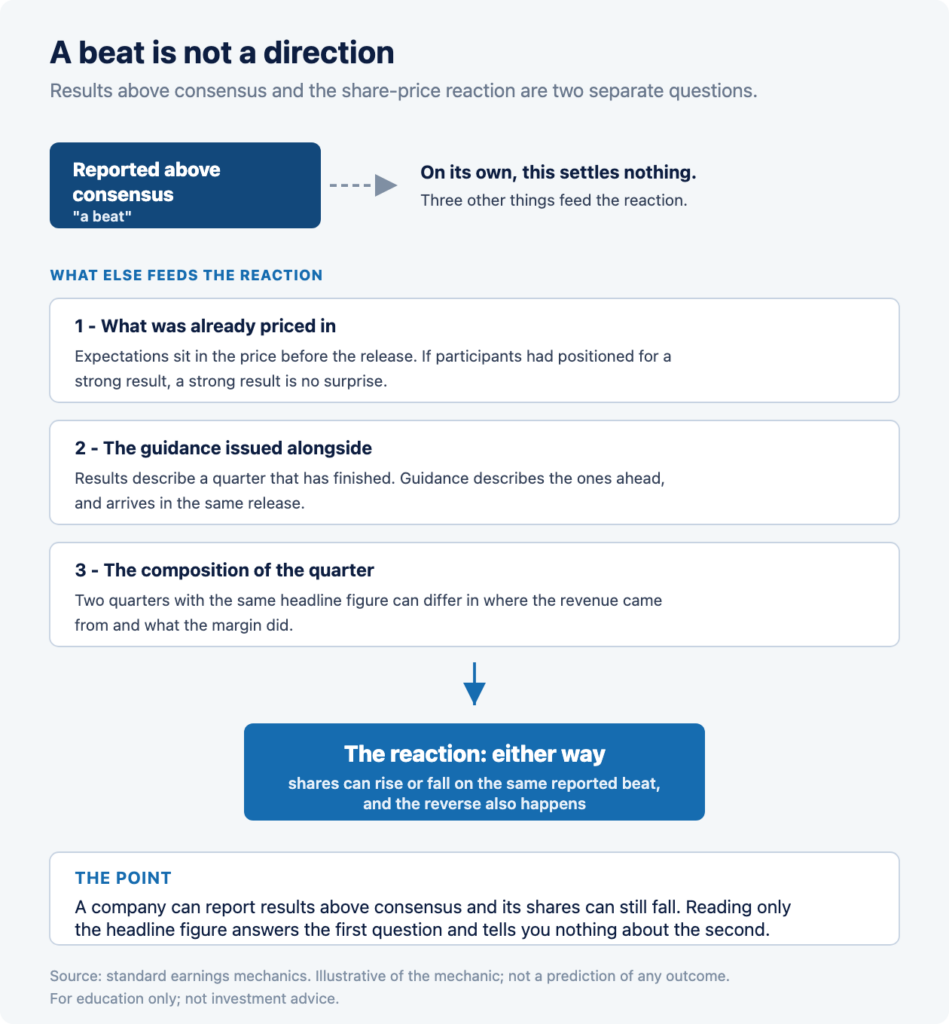
Expectations sit in the price before the release. If participants had already positioned for a result above consensus, a result above consensus may be no surprise at all. The move responds to the gap between the outcome and what was anticipated, not to the outcome by itself.
The guidance issued alongside
Results describe a quarter that has finished. Guidance describes the ones ahead. A report can beat on the closed quarter and guide below expectations for the next, and market commentary frequently attributes the reaction to the second rather than the first.
The composition of the quarter
Two quarters with the same EPS can differ in where the revenue came from, what the margin did, and what the company said about demand. Those details sit inside the release and the call, which is part of why both are published.
How the market commonly reads a Palantir print
Coverage of a print generally distinguishes between the reported figures, the guidance issued with them, and the commentary on the call. Because the release lands after the close and the webcast follows at 5:00 p.m. ET, that reading happens across the after-hours session and into the next morning rather than inside a single regular session. [1] [4]
The sessions involved
After-hours and premarket sessions carry thinner liquidity and wider spreads than regular hours, and prices in them can move quickly in either direction as the release and then the call are absorbed. Reversals between the initial reaction and the following session are common enough to be unremarkable. Trading those conditions involves substantial risk. Most day traders lose money.
Where to read the release itself
The results are published on Palantir’s investor-relations site and filed with the SEC. Both are freely available. Reading the release and the guidance directly is what makes the coverage legible.
What this article does not answer, and why
Most of the search demand around this topic asks a question this page will not answer. The common questions include whether Palantir is expected to beat, whether the shares can reach a particular price, and whether Palantir is worth buying now.
The reason is not evasiveness
CMEG is authorized as a broker-dealer and does not publish investment recommendations, price targets, or forecasts of what a security will do. That applies whether the answer would be favourable or unfavourable. This page reports what the company has scheduled, what it has published, what analysts have estimated, and how the mechanics work. It stops there, deliberately.
What a reader can do with this page instead
Everything above is checkable. The date traces to the company’s own announcement, the guidance and the last quarter’s figures to a filing with the SEC, and the estimates and surprise history to a named data provider on a stated retrieval date. That gives a factual basis for reading the coverage that follows the print, and for noticing when a preview quotes an expectation without saying whose it is. Whether to hold a position through a scheduled earnings event is a decision for the individual, and it carries substantial risk.
Risks and limitations
- The next print is not knowable. Nothing on this page forecasts Q2 results or the share-price reaction to them.
- Estimates move. The consensus figures here were retrieved on a stated date and change as analysts revise. Re-check before relying on them.
- The date can change. Companies occasionally reschedule. The company’s announcement is the authority, and third-party calendars have been observed to disagree with it.
- History does not repeat. Four prior beats say nothing about a fifth.
- Holding through a print is a high-risk activity. A scheduled event can produce a large gap in either direction, and after-hours and premarket sessions carry limited liquidity and wide spreads. Prices can move sharply against a position immediately. Most day traders lose money, and leverage amplifies both gains and losses, meaning you can lose more than you deposit.
- This is not advice. Nothing here is a recommendation to trade any security, at any time, around any event.
What comes next
Palantir’s Q2 2026 results are scheduled for Monday, August 3, 2026, after the U.S. close, with the webcast at 5:00 p.m. ET. [1] Following that, the company’s Q3 2026 report is currently calendared for November 2, 2026, though that date is a data-provider projection rather than a company announcement and should be confirmed against Palantir’s investor-relations releases when it is announced. [3] This page will update with the Q2 figures, a refreshed surprise table, and the confirmed Q3 date after the print.
Frequently asked questions
When is Palantir’s next earnings date?
Palantir will release second-quarter 2026 results on Monday, August 3, 2026, following the close of U.S. markets, with a webcast at 5:00 p.m. ET. The date comes from Palantir’s own announcement of July 13, 2026, which is the authoritative source rather than a third-party calendar.
What time does Palantir report earnings?
The results are published after the close of U.S. markets, which is 4:00 p.m. ET, and the company hosts its webcast at 5:00 p.m. ET. Because the release lands after the close, the first regular session in which markets can respond is the following morning at 9:30 a.m. ET.
What is the consensus estimate for Palantir’s quarter?
Published estimates retrieved on July 17, 2026 ranged from roughly $0.33 to $0.354 per share depending on the data provider. This page cites Finnhub’s figure of about $0.354. A consensus is an average of analyst forecasts assembled by a provider, not an official company figure.
What revenue has Palantir guided to for the quarter?
In its first-quarter 2026 release, Palantir said it expected second-quarter revenue of between $1.797 billion and $1.801 billion, and adjusted income from operations of between $1.063 billion and $1.067 billion. Guidance is published by the company itself, unlike consensus estimates.
What did Palantir report last quarter?
For the first quarter of 2026, released May 4, 2026, Palantir reported revenue of $1.633 billion, up 85% year over year, GAAP net income of $871 million, GAAP diluted EPS of $0.34, and adjusted diluted EPS of $0.33, with an adjusted operating margin of 60 percent.
What is the difference between GAAP and adjusted EPS?
GAAP earnings per share follows standard accounting rules; adjusted EPS excludes items the company treats as non-representative, commonly stock-based compensation. Palantir reported both for its first quarter of 2026: $0.34 on a GAAP basis and $0.33 adjusted. Consensus estimates are generally compiled on the adjusted basis.
What is an expected move around earnings?
It is a range implied by options pricing ahead of a scheduled event, indicating how large a move the options market implies in either direction. It does not indicate direction. Implied volatility is generally elevated before a print and commonly falls once results are public.
Does a Palantir earnings beat mean the stock will rise?
No. A company can report above consensus and its shares can still fall, and the reverse also happens. What was already priced in before the release, the guidance issued alongside the results, and the composition of the quarter all contribute to the reaction, not the headline figure alone.
References
[1] Palantir Technologies Inc., “Palantir Announces Date of Second Quarter 2026 Earnings Release and Webcast,” investor relations, July 13, 2026. https://investors.palantir.com/news-details/2026/Palantir-Announces-Date-of-Second-Quarter-2026-Earnings-Release-and-Webcast/
[2] Palantir Technologies Inc., Q1 2026 earnings press release, Exhibit 99.1 to Form 8-K, filed with the U.S. Securities and Exchange Commission May 4, 2026. https://www.sec.gov/Archives/edgar/data/1321655/000132165526000026/a2026q1ex991pressrelease.htm
[3] Finnhub, earnings calendar and company earnings surprise data for PLTR, retrieved via the Finnhub API on July 17, 2026: endpoints /api/v1/calendar/earnings?symbol=PLTR and /api/v1/stock/earnings?symbol=PLTR. These endpoints require an API key, so the figures cannot be reproduced from a public link; the raw, unedited API responses as retrieved on that date are retained on file and are available to reviewers on request. Provider documentation: https://finnhub.io/docs/api/company-earnings
[4] New York Stock Exchange, “Hours and Calendars.” https://www.nyse.com/trade/hours-calendars
[5] Palantir Technologies Inc., Form 8-K, filed with the U.S. Securities and Exchange Commission May 4, 2026 (CIK 0001321655). https://www.sec.gov/Archives/edgar/data/1321655/000132165526000026/pltr-20260504.htm
Disclosures: Trading involves substantial risk and is not suitable for every investor. Capital is at risk and most day traders lose money. Leverage amplifies both gains and losses, and you can lose more than you deposit. Client accounts are not SIPC or FSCS insured. Extended-hours trading carries additional risk, including lower liquidity and wider spreads. This content is provided for information and education only, for self-directed traders. It is not investment advice or a recommendation of any security, strategy, or account type. Palantir Technologies Inc. is named here solely as the factual subject of a scheduled corporate event; naming it is not a recommendation. Figures are sourced from Palantir Technologies Inc., the U.S. Securities and Exchange Commission, and Finnhub as dated above. See our full disclosures and policies.