
The Federal Open Market Committee meets on July 28–29, 2026. The policy statement is released at 2:00 p.m. Eastern Time on Wednesday, July 29, followed by the Chair’s press conference at 2:30 p.m. ET. This is one of the four 2026 meetings that does not include a Summary of Economic Projections, so there is no dot plot. This is factual reporting, not investment advice or a forecast of any rate decision.
Data on this page is current as of July 16, 2026. Meeting dates and release times are from the Federal Reserve; rate and yield figures are from FRED. This page is updated after each FOMC meeting.
What time is the FOMC rate decision released?
The FOMC policy statement is published at 2:00 p.m. ET on the second day of a two-day meeting. The Federal Reserve timestamps this directly: its page for the June 2026 meeting records the statement, the implementation note, and the projection materials as all “Released June 17, 2026 at 2:00 p.m.”
That timing places the release in the middle of the regular U.S. equity session, which is what separates a Fed day from a data day. A Consumer Price Index or jobs report lands at 8:30 a.m. ET, an hour before the opening bell, so the first reaction shows up in index futures and premarket trading. The FOMC statement lands with the cash market already open and roughly two hours of the session still to run.
The Chair’s press conference follows at 2:30 p.m. ET. The Federal Reserve’s July 2026 events calendar lists the FOMC Press Conference at 2:30 p.m. on the 29th, thirty minutes after the statement.
That thirty-minute gap matters structurally. The statement is a short, fixed document. The press conference is unscripted question-and-answer that can run close to an hour. They are two distinct events on the same afternoon, and they can be read differently from one another.
When is the July 2026 FOMC meeting?
The July 2026 meeting is a two-day meeting held Tuesday, July 28 and Wednesday, July 29, with the policy decision on the 29th. This appears on the Federal Reserve’s own FOMC calendar, which the Board last updated on July 8, 2026.
One nuance is worth stating plainly, because it is often missed. The Federal Reserve notes that “each meeting date is tentative until confirmed at the meeting immediately preceding it.” The July 28–29 dates were confirmed at the June 16–17 meeting. Dates published a year in advance are a schedule, not a guarantee, and the Committee can also hold unscheduled meetings as needed — the Fed describes its eight regular meetings as the standing calendar, with “other meetings as needed.”
Why the July meeting has no dot plot
Four of the eight annual FOMC meetings include a Summary of Economic Projections. Four do not. July 2026 is one of the four that does not.
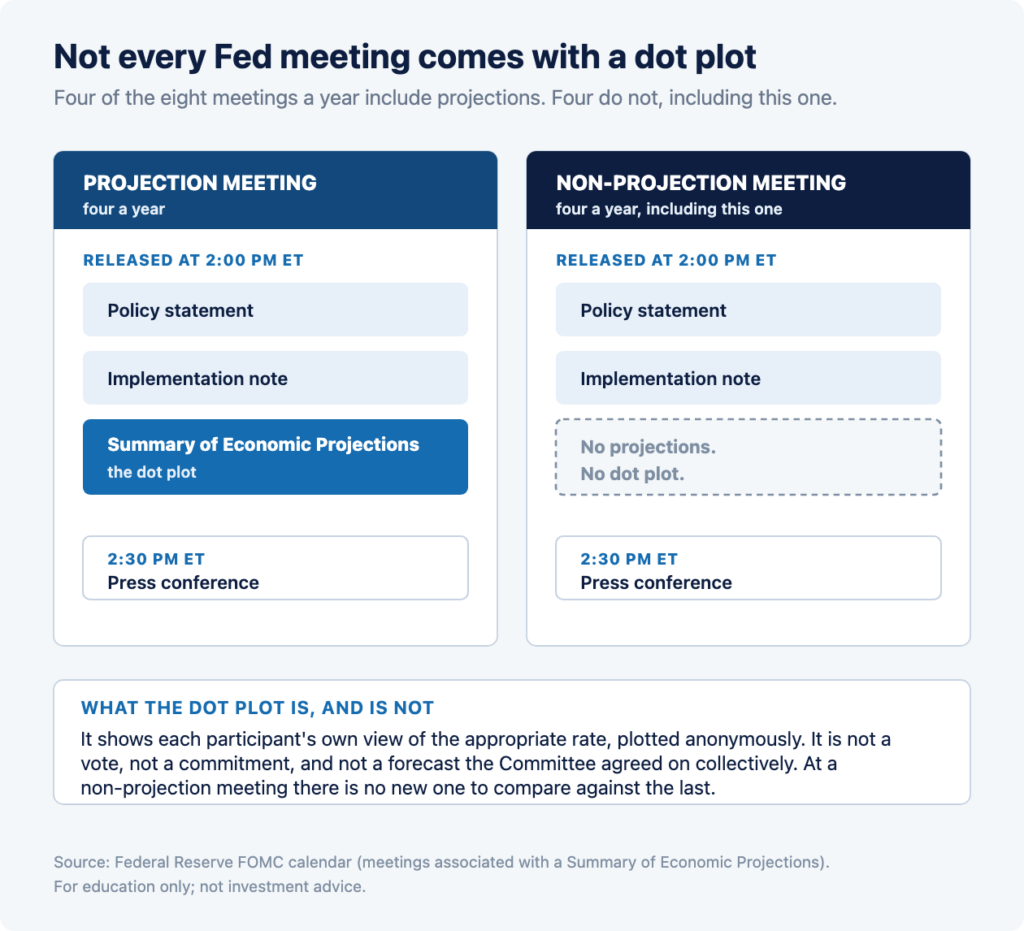
The Federal Reserve marks this on its calendar with an asterisk and a footnote reading “Meeting associated with a Summary of Economic Projections.” In 2026 the asterisked meetings are March 17–18, June 16–17, September 15–16 and December 8–9. January, April, July and October carry no asterisk.
This is a genuinely consequential mechanical detail, and it is frequently misunderstood. The Summary of Economic Projections is the document that contains the “dot plot” — the chart showing where each participant thinks the appropriate policy rate will sit at the end of coming years. It is the single most-discussed artifact of a Fed meeting, and it will not exist on July 29.
What that means in practice is that the July meeting produces a smaller set of documents than the June meeting did: a statement and an implementation note at 2:00 p.m., then a press conference at 2:30 p.m. There is no new projection material to compare against the last round. The next dot plot is scheduled for the September 15–16 meeting.
The 2026 FOMC calendar
The Committee holds eight regularly scheduled meetings a year. Four are behind us in 2026; four remain.
| Meeting | Dates | Projections (dot plot)? | Status |
| January | 27–28 | No | Held |
| March | 17–18 | Yes | Held |
| April | 28–29 | No | Held |
| June | 16–17 | Yes | Held |
| July | 28–29 | No | Upcoming |
| September | 15–16 | Yes | Scheduled |
| October | 27–28 | No | Scheduled |
| December | 8–9 | Yes | Scheduled |
The pattern is regular: a projections meeting roughly every quarter, with the intervening meetings producing a statement and a press conference only.
Where the federal funds target range stands today
The federal funds target range is currently 3.50% to 3.75%, per the Federal Reserve Economic Data series for the upper and lower bounds of the target.
That range has been in place since December 11, 2025, the day after the December 9–10, 2025 meeting. The Committee has left it unchanged at every meeting held since: January, March, April and June of 2026. As of the July meeting, the range will have stood at 3.50%–3.75% for roughly seven and a half months.
How the current target range was set
The current range is the product of three consecutive quarter-point cuts in the autumn of 2025, each of which is visible as a step in the FRED target-range series.
| Decision date | Move | New target range |
| Sep 18, 2024 | −50 bp | 4.75% – 5.00% |
| Nov 7, 2024 | −25 bp | 4.50% – 4.75% |
| Dec 18, 2024 | −25 bp | 4.25% – 4.50% |
| Held through 2025 H1 | ||
| Sep 17, 2025 | −25 bp | 4.00% – 4.25% |
| Oct 29, 2025 | −25 bp | 3.75% – 4.00% |
| Dec 10, 2025 | −25 bp | 3.50% – 3.75% |
| Held at every 2026 meeting to date (Jan, Mar, Apr, Jun) |
Read as a sequence, the pattern is three cuts in four months, then a pause that has now run through four consecutive meetings. Whether the July meeting extends that pause is decided at the meeting, and this article does not attempt to anticipate it.
Why the target is a range, not a single number
A detail that trips up almost everyone reading Fed coverage for the first time: the Committee does not set an interest rate. It sets a quarter-point-wide range, and then a separate set of tools keeps the actual market rate inside it.
The federal funds rate is the rate at which banks lend reserves to each other overnight. It is a market rate — it is not administered, and the Federal Reserve cannot simply declare it. What the Committee can do is set the boundaries and the incentives that keep it where it wants it.
That is the job of the implementation note, the second document released at 2:00 p.m. alongside the statement. It is routinely ignored in coverage, and it is where the decision actually becomes operational.
The June 2026 implementation note is a concrete example of the structure.
| Tool | Rate | Where it sits |
| Standing overnight repo operations | 3.75% | Top of the range |
| Primary credit rate (the discount window) | 3.75% | Top of the range |
| Interest on reserve balances (IORB) | 3.65% | Inside the range — the main steering lever |
| Overnight reverse repo (ON RRP) offering rate | 3.50% | Bottom of the range |
| Target range (what the Committee votes on) | 3.50% – 3.75% | The band the others enforce |
Read the table from the outside in and the logic is visible. A bank with reserves has little reason to lend them below 3.50%, because it can park them at the Federal Reserve overnight and earn that instead. Equally, there is little reason to borrow at much above 3.75% when the standing repo facility and the discount window are available at that rate. The interest paid on reserve balances, at 3.65%, sits between the two and is the lever the Board adjusts most directly.
The same note also directs the New York Fed’s Open Market Desk to “undertake open market operations as necessary to maintain the federal funds rate in a target range of 3-1/2 to 3-3/4 percent” — the operational instruction that sits behind the headline.
Two things follow from this. The quarter-point steps in the table above are quarter-point moves of the whole band, not of a single number. And the phrase “the Fed raised rates” is shorthand: the Committee moves a range, and a set of administered rates does the enforcing.
What happens on Fed decision day, step by step
For a non-projection meeting like July, the afternoon has a fixed shape.
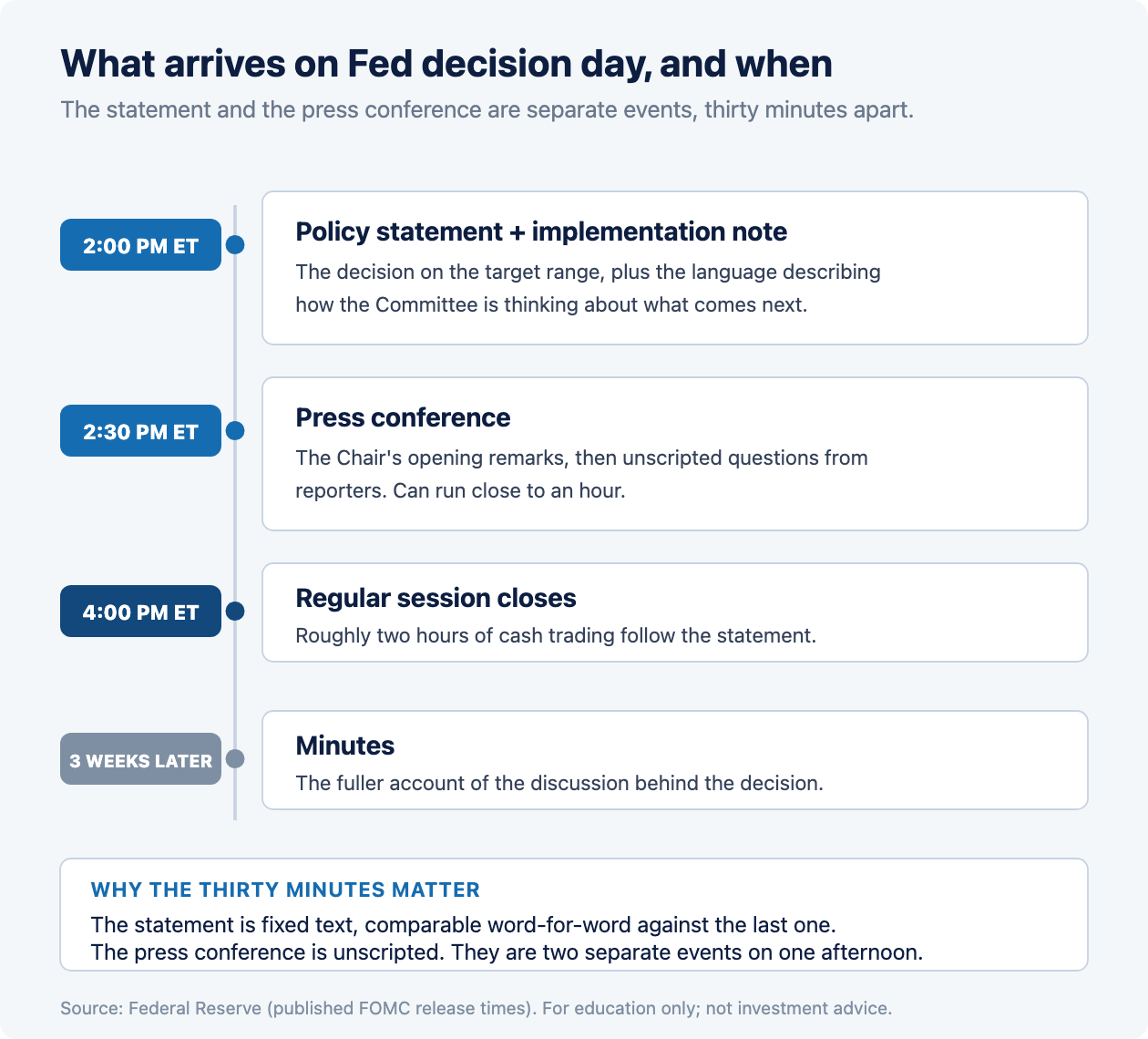
| Time (ET) | What is released | What it is |
| 2:00 p.m. | Policy statement | The decision itself, plus the Committee’s description of conditions and its guidance |
| 2:00 p.m. | Implementation note | The technical settings that put the decision into effect |
| 2:30 p.m. | Press conference | The Chair’s opening remarks, then unscripted questions from reporters |
| 4:00 p.m. | (Regular session closes) | Roughly two hours of cash trading follow the statement |
| ~3 weeks later | Minutes | The fuller account of the discussion behind the decision |
On a projection meeting — September, for instance — the Summary of Economic Projections is added to the 2:00 p.m. release. July does not have that step.
What the FOMC statement actually contains
The statement is short, and much of it is unchanged from meeting to meeting. That is by design, and it is why market participants commonly compare it line by line against the previous one.
It generally covers the Committee’s characterization of economic activity and the labour market, its characterization of inflation, the decision on the target range, and language describing how the Committee is thinking about what comes next. The implementation note released alongside it sets out the technical mechanics that put the decision into effect.
Because the structure repeats, changes in wording carry weight that the raw decision may not. A statement can leave the target range untouched and still be read as a meaningful shift, purely through revised language. That is a large part of why a “no change” meeting is not the same thing as an uneventful one.
What the Summary of Economic Projections adds
At the four projection meetings, the 2:00 p.m. release also includes the Summary of Economic Projections. It gathers each participant’s individual projections for growth, unemployment, inflation and the appropriate policy rate over the coming years.
The dot plot is the portion showing each participant’s view of the appropriate policy rate at the end of each year, plotted as anonymous dots. It is not a commitment, not a vote, and not a forecast the Committee has agreed on collectively — it is a snapshot of individual views on the day. The Federal Reserve publishes it as projection material, not as guidance.
For the July meeting, none of this applies. The next Summary of Economic Projections is scheduled for September 15–16, 2026.
When are the FOMC minutes released?
The Federal Reserve states that “the minutes of regularly scheduled meetings are released three weeks after the date of the policy decision.”
The 2026 releases bear this out precisely. The January 28 decision produced minutes on February 18. March 18 produced April 8. April 29 produced May 20. June 17 produced July 8. Each is three weeks to the day, and each is released at 2:00 p.m. ET.
Applying the same rule, the minutes from the July 29 decision are due around August 19, 2026. That date follows from the Fed’s stated three-week convention rather than from a separately published calendar entry, so it is best treated as expected rather than confirmed.
How the market prices rate expectations between meetings
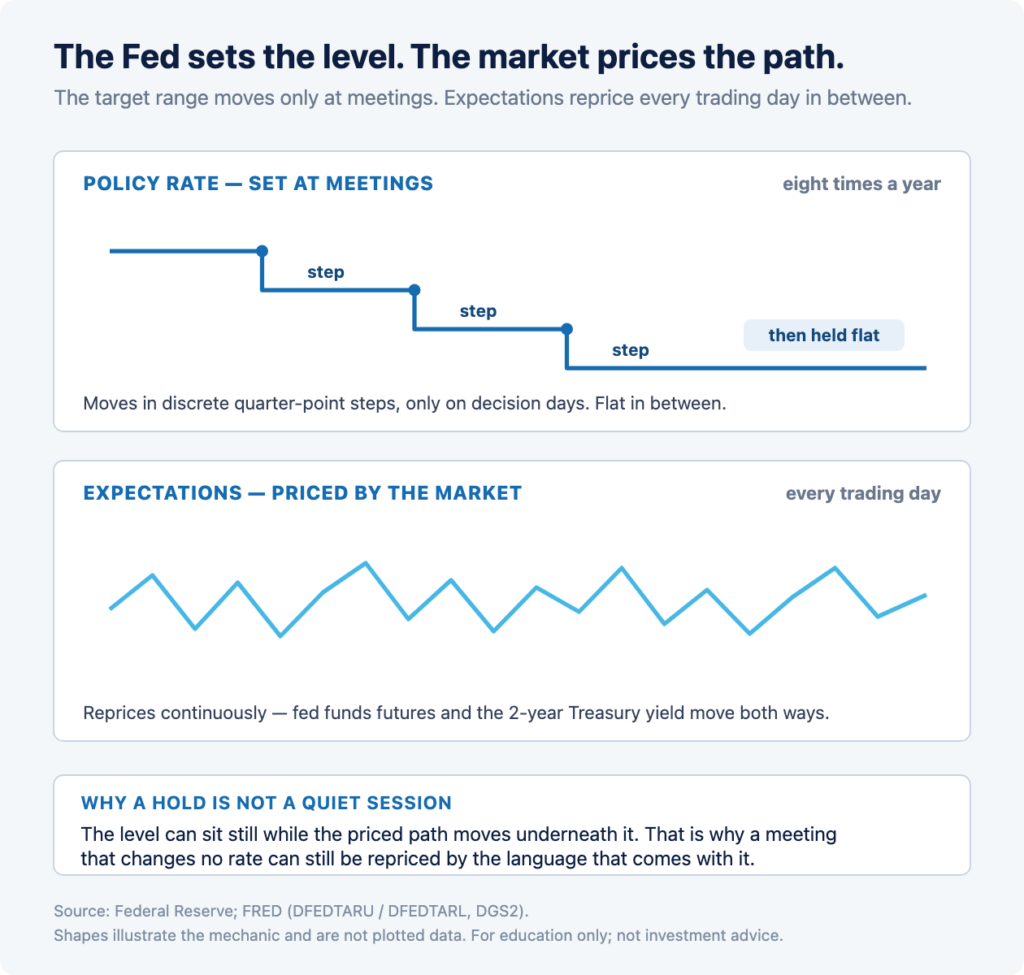
Between meetings, expectations about the policy rate are expressed continuously in markets rather than announced.
Federal funds futures are the instrument most directly tied to the policy rate, since they settle against the effective federal funds rate. Probabilities derived from those contracts are widely reported — CME Group’s FedWatch tool is the most commonly cited presentation of them.
Two points about those probabilities are worth stating clearly, because they are routinely blurred in coverage. First, they are market pricing, not a forecast by the Federal Reserve or by anyone else; they describe what the market is positioned for, which is a different thing from what will happen. Second, they are not this firm’s view of anything — Roosterly reports them as observable market data.
The 2-year Treasury yield is also commonly tracked in this context. Because a 2-year note spans roughly the horizon over which the policy rate is expected to move, market participants often treat it as a prominent indicator of expectations for the policy path. It is one such indicator among several, not a definitive one.
What the 2-year Treasury yield did on 2026 decision days
This is where the mechanics become concrete, and the record is more interesting than it first appears.
| Meeting | Decision | Prior session | Decision day | Change |
| Jan 27–28 | No change | 3.53% | 3.56% | +3 bp |
| Mar 17–18 | No change | 3.68% | 3.76% | +8 bp |
| Apr 28–29 | No change | 3.84% | 3.92% | +8 bp |
| Jun 16–17 | No change | 4.05% | 4.20% | +15 bp |
At all four 2026 meetings the Committee left the target range unchanged. On all four decision days the 2-year yield closed higher than the prior session. The moves were small in absolute terms and they are not evidence of a rule — four observations is a small sample, and yields move on many things at once, including data and supply that have nothing to do with the meeting.
But the pattern illustrates the mechanic this article is about. The decision itself was “no change” every time. The repricing that market participants observed on those afternoons is commonly interpreted as a response to the guidance and the press conference rather than to the target range, because the target range did not move.
Why the level is not the whole story
Extend the window and the point sharpens considerably.
| Month-end | 2-year yield | Target range |
| Nov 2025 | 3.47% | 3.75% – 4.00% |
| Dec 2025 | 3.47% | 3.50% – 3.75% |
| Jan 2026 | 3.52% | 3.50% – 3.75% |
| Feb 2026 | 3.38% | 3.50% – 3.75% |
| Mar 2026 | 3.79% | 3.50% – 3.75% |
| Apr 2026 | 3.88% | 3.50% – 3.75% |
| May 2026 | 3.98% | 3.50% – 3.75% |
| Jun 2026 | 4.14% | 3.50% – 3.75% |
| Jul 15, 2026 | 4.13% | 3.50% – 3.75% |
Between the February 2026 low of 3.38% and mid-July, the 2-year yield rose by roughly three quarters of a percentage point. Across that entire stretch the Federal Reserve did not change the target range once.
Two observations follow, both factual. The policy rate is set at meetings, eight times a year, in quarter-point steps. Expectations about that rate reprice continuously, in between, and can travel a long way while the rate itself sits still.
And as of July 15, 2026, the 2-year yield of 4.13% sits above the 3.75% top of the current target range. Market participants generally read a 2-year yield above the current range as pricing that reflects expectations other than near-term cuts over that horizon. That is a description of where the market is positioned, not a prediction, and positioning can change on any given afternoon — including this one.
Why the July meeting falls in an unusually dense week
The July decision does not arrive in isolation, which is unusual even by Fed-week standards.
The Bureau of Economic Analysis is scheduled to publish the advance estimate of second-quarter GDP together with the Personal Consumption Expenditures price index at 8:30 a.m. ET on July 30 — the morning after the decision. PCE is the inflation measure the Federal Reserve’s 2% target is defined on, which is why it draws attention that the Consumer Price Index does not, despite CPI being the more familiar number. Our CPI report hub and PPI report hub cover the other two legs of the inflation data set.
Several of the largest U.S. companies by market capitalisation are also scheduled to report in the same window, with Microsoft and Meta expected on July 29 and Apple and Amazon on July 30, per earnings-calendar data compiled by Finnhub. Scheduled reporting dates are set by the companies and can move.
The result is a Fed decision on Wednesday afternoon, mega-cap earnings that same evening and the next, and the Fed’s preferred inflation gauge plus the first read on Q2 growth on Thursday morning. Liquidity and volatility conditions around clustered events like this can differ materially from a normal session, in both directions. For the longer arc of the cut cycle itself, see our 2026 rate-cut cycle pillar.
How the market commonly reads a Fed decision
Coverage of Fed day tends to compress into “did they cut or not.” The observable behaviour of markets is less binary than that, and understanding the difference is most of the value in following the event at all.
What market participants commonly compare is the decision against what was already priced in. A cut that was fully expected is, in pricing terms, already in the market before the statement is released. A hold accompanied by unexpected language can be repriced more than a widely anticipated cut. This is the same surprise-versus-level dynamic that governs the reaction to scheduled data releases, and it is why the 2026 record above shows movement on four consecutive “no change” days.
The statement and the press conference are also commonly read as two separate events. The statement is fixed text and can be compared word-for-word against the previous one. The press conference is unscripted, runs long, and has historically been where the tone of the afternoon can shift after the initial reaction to the statement. Sessions have been observed moving in one direction at 2:00 p.m. and differently after 2:30 p.m.
None of this is a method for anticipating the outcome. It describes what is observable about how the session is structured.
Risks and limitations
A few limitations apply to everything above, and they are not boilerplate.
The historical figures on this page describe what has already happened. Four decision days in 2026 is a small sample, drawn from a single stretch in which the Committee held every time. It does not establish a pattern, and it says nothing about July 29.
Nothing here anticipates the July decision, the language of the statement, the content of the press conference, or the direction of any market. Probabilities derived from federal funds futures describe market pricing, not knowledge, and pricing has been wrong before.
Conditions around clustered scheduled events can be unusually volatile. Spreads can widen, and the price at which an order is filled can differ from the price displayed when it was entered, particularly in the minutes immediately following a 2:00 p.m. release. Those risks apply regardless of which way a market moves.
Frequently asked questions
When is the next FOMC meeting?
The FOMC meets July 28–29, 2026, with the policy decision on Wednesday, July 29. The remaining 2026 meetings are September 15–16, October 27–28, and December 8–9, per the Federal Reserve’s FOMC calendar. Each date is tentative until confirmed at the meeting immediately preceding it, and the Committee may also meet unscheduled.
What time is the Fed rate decision announced?
The FOMC policy statement is released at 2:00 p.m. ET on the second day of the meeting, alongside the implementation note. The Chair’s press conference follows at 2:30 p.m. ET and can run close to an hour. Because the release lands mid-session, roughly two hours of cash trading follow it.
Is there a dot plot at the July 2026 meeting?
No. July is one of the four 2026 meetings held without a Summary of Economic Projections, so no dot plot is published. The Federal Reserve marks projection meetings with an asterisk on its calendar; in 2026 those are March, June, September and December. The next dot plot comes at the September 15–16 meeting.
What is the current federal funds target range?
The target range is 3.50% to 3.75%, in place since December 11, 2025, following the December 9–10, 2025 decision. The Committee has left it unchanged at all four 2026 meetings held so far — January, March, April and June — per Federal Reserve Economic Data. Whether July extends that pause is decided at the meeting.
Why is the Fed’s target a range instead of a single rate?
The federal funds rate is a market rate set between banks, not one the Federal Reserve can declare. The Committee votes on a quarter-point-wide range, and administered rates set in the implementation note — interest on reserve balances, the overnight reverse repo offering rate, the standing repo rate — keep the market rate inside that band.
When are the July FOMC minutes released?
The Federal Reserve states that minutes are released three weeks after the policy decision, at 2:00 p.m. ET. That places the July 29 minutes around August 19, 2026. The 2026 releases follow the rule precisely: the June 17 decision produced minutes on July 8, and April 29 produced May 20.
How many FOMC meetings are there each year?
The Federal Open Market Committee holds eight regularly scheduled meetings a year, per the Federal Reserve, and may hold other meetings as needed. Four of the eight include a Summary of Economic Projections. The minutes of each regularly scheduled meeting are released three weeks after the policy decision.
Who chairs the FOMC?
Kevin Warsh serves as Chairman of the Board of Governors of the Federal Reserve System, per the Board’s published roster as of July 2026, with Philip N. Jefferson as Vice Chair. The Chair leads the press conference that follows the policy statement, beginning at 2:30 p.m. ET on decision day.
Disclosures: Trading involves substantial risk and is not suitable for every investor. Trading around scheduled events such as FOMC decisions can be especially volatile, and conditions in the minutes following a 2:00 p.m. ET release can differ materially from a normal session. Capital is at risk and most day traders lose money. Leverage, where offered, amplifies both gains and losses, and you can lose more than you deposit. Client accounts are not SIPC or FSCS insured. This content is provided for information and education only. It is not investment advice or a recommendation of any security, and it does not predict interest rates, the FOMC’s decision, or any market. Meeting dates and release times are from the Federal Reserve; rate and yield figures are from FRED, as dated above. See our full disclosures and policies.