
The AI trade in 2026 spans several layers of the market: the chipmakers, the cloud companies spending on AI infrastructure, the power and energy names supplying data centers, and the software firms building on top. The engine underneath is capital expenditure, which the largest cloud companies have roughly tripled since 2022, according to their SEC filings. Whether that spending is sustainable is a genuine, ongoing debate. This is a map of the complex, not a recommendation to buy any of it.
This content is for information and education only and is not investment advice, and it is not a recommendation of any security. Data is current as of July 3, 2026.
What is the state of the AI trade in 2026?
The AI trade in 2026 is a broad, connected group of stocks rather than a single sector, and it has been one of the market’s most active and most debated themes. It links chipmakers, cloud providers, power suppliers, and software companies, and it tends to move together on shared catalysts.
A theme, not a sector
Because the AI trade cuts across semiconductors, technology, utilities, and industrials, a single catalyst can often move names in several sectors at once. That connectedness is why traders watch it as one theme, and why a piece of news about chip demand or data-center power can ripple through a dozen tickers.
Active and contested
The theme is both heavily traded and heavily argued over. On the same week, one side points to record infrastructure spending and the other to stretched valuations. This article lays out both sides as they are reported, without taking a position on which is right.
How is the AI complex structured?
The AI complex is best understood as a stack of layers, from the chips at the base to the software applications at the top, with cloud infrastructure and power in between. Each layer plays a different role and carries a different trading character.
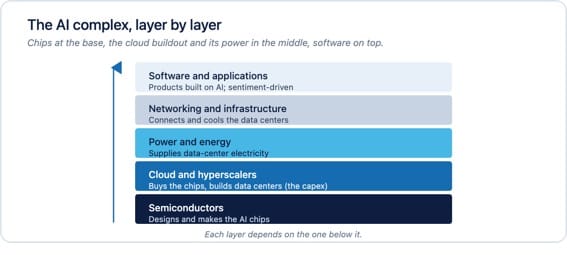
The AI complex as a stack: chips at the base, the cloud buildout and its power supply in the middle, and software applications on top.
| Layer | What it does | Example listed names | Trader-relevant trait |
| Semiconductors | Designs and makes AI chips | Nvidia, AMD, Broadcom, Micron | High volatility; earnings are major catalysts |
| Cloud / hyperscalers | Buys the chips, builds data centers | Microsoft, Alphabet, Amazon, Meta | Large-cap; capex guidance moves the theme |
| Power and energy | Supplies data-center electricity | Constellation Energy, Oklo, GE Vernova | The newer leg; power-deal driven |
| Networking / infrastructure | Connects and cools data centers | Broadcom and networking names | Moves with the buildout cycle |
| Software / applications | Builds products on AI | Palantir and application names | Sentiment-driven; high multiples debated |
The AI complex by layer. Example listed names are shown for reference only and are not recommendations.
Why the layers matter for trading
The layers do not move identically. A chip catalyst hits the semiconductor layer first; a hyperscaler’s capex guidance moves the cloud layer and then the chip and power names that depend on it. Knowing which layer a catalyst belongs to helps a trader understand why a group of names is moving together. The names above are listed as members of each layer, not as suggestions to trade.
What is driving it? The capex cycle
The engine under the AI trade is capital expenditure: the spending by large cloud companies on the chips, data centers, and power that AI requires. That spending has ramped sharply, and it is the most concrete, filing-verified number in the whole theme.
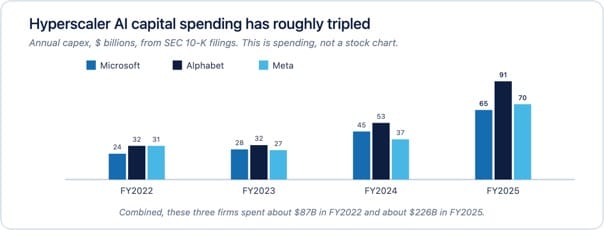
Annual capital spending by Microsoft, Alphabet, and Meta, from their SEC filings. This is capital spending, not a stock chart or a forecast.
The numbers, from the filings
According to their 10-K filings, Microsoft’s annual capital expenditure rose from about $23.9 billion in fiscal 2022 to about $64.6 billion in fiscal 2025. Over the same period Alphabet’s rose from about $31.5 billion to about $91.4 billion, and Meta’s from about $31.4 billion to about $69.7 billion. Combined, those three companies spent roughly $87 billion in fiscal 2022 and roughly $226 billion in fiscal 2025, close to a tripling in three years. Amazon’s capital spending is also large and rising, reported under a separate line in its filings.
Why capex is the tell
Capex is a spending figure, not a stock price and not a forecast, which is exactly why traders watch it: it shows how much real money the largest buyers are committing to AI infrastructure. When a hyperscaler raises or lowers its capex guidance on an earnings call, the chip and power names that depend on that spending often move with it. The capex cycle is the theme’s clearest fundamental signal, and it is why the hyperscalers’ earnings are watched across the whole complex.
The bull case, as it is reported
The bull case for AI stocks, as argued by its supporters, rests on real and growing demand for AI computing, the record infrastructure spending behind it, and rising revenue at the companies supplying it. Presented here as reporting, not as our view.
The arguments supporters make
Proponents point to the capex figures above as evidence of durable demand, to chipmakers’ revenue growth, and to broadening adoption of AI across industries. They argue that the buildout is early and that the companies spending the most have the balance sheets to sustain it. These are the arguments made by AI bulls; whether they prove correct is unknown, and nothing here endorses them.
The bear case and the AI-bubble debate
The bear case, as argued by skeptics, questions whether the spending can be sustained, whether the returns will justify it, and whether valuations have run ahead of fundamentals. This debate is live and unresolved, and reputable outlets carry both sides.
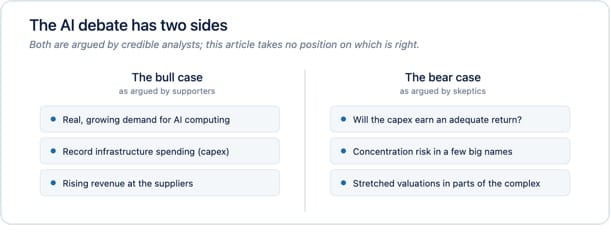
The AI debate has two sides, both argued by reputable analysts and outlets. This article reports both and takes no position on which is right.
The arguments skeptics make
Skeptics ask whether hundreds of billions in annual capex will earn an adequate return, point to concentration risk in a handful of very large names, and question stretched valuations in parts of the complex. In early July 2026, Bloomberg reported that the AI trade was “losing one of its key signals,” an example of the kind of caution that appears alongside the bullish coverage. The point for a trader is that credible people disagree, so the theme carries real two-way risk. This article does not judge the debate; it reports that the debate exists.
The AI-energy angle
AI has become a power trade because data centers consume large amounts of electricity, which has pulled utilities, nuclear operators, and power-equipment makers into the theme. This is the newer leg of the AI complex and one of its most active in 2026.
From chips to megawatts
As the buildout has grown, the constraint has shifted toward electricity, and power names have moved on data-center demand and power-purchase agreements. In early July 2026, CNBC reported on GE Vernova as one company “winning from the AI boom” through its power business, an example of the coverage tying energy names to AI. Constellation Energy and Oklo are among the listed names in this layer, and their earnings are watched as catalysts. As always, these are members of the theme, not recommendations.
New listings keep reshaping the complex
The AI complex is not fixed; new public listings keep adding tradable names as private AI companies come to market. That flow of new supply is part of why the theme stays active, and it is worth tracking as a source of new catalysts.
From private to public
Several of the most talked-about AI companies have been private, and some have moved toward public markets. SpaceX listed in June 2026, and the AI-chip company Cerebras has filed to go public. Others, such as OpenAI and Anthropic, have been reported as potential future listings, but as of early July 2026 they had not filed public IPO paperwork with the SEC, so any timing or valuation figures circulating are press reporting rather than confirmed fact.
Why new listings matter for the theme
Each new AI listing adds a tradable name and a fresh set of catalysts, and new listings tend to be especially volatile because they have little or no trading history and are subject to lockup periods that affect share supply later. A trader following the theme watches the IPO calendar as one more input, alongside the earnings calendar. New listings are covered in more depth in our IPO content; the point here is that the roster of AI names is still growing.
How does the AI complex trade?
The AI complex tends to trade with high correlation and frequent sympathy moves, meaning a catalyst for one name often moves its peers. It also carries high single-name volatility, especially around chip earnings.
Correlation and sympathy moves
Because the layers depend on each other, a strong or weak result from one large name can move the others in sympathy, even before those companies report. A chip catalyst can move the whole semiconductor layer and the hyperscalers that buy from it. This connectedness cuts both ways: the theme can rise together and fall together.
Volatility and concentration
Individual AI names can move sharply around catalysts, and the theme is concentrated in a handful of very large companies, so a move in one megacap can swing the broader market indexes. For an active trader, that concentration and volatility is a risk-management question as much as a trading one; position sizing and risk controls matter more when a theme moves this fast, and leverage amplifies both gains and losses.
The index effect
The largest AI names have grown into some of the biggest weights in the major indexes, so a sharp move in one of them can pull the whole index with it. That means the AI theme now influences the broad market, not just its own corner of it, and a trader watching the indexes is partly watching the AI megacaps. It also concentrates risk: when a few names carry that much weight, their earnings reactions ripple well beyond the individual stocks.
The catalyst calendar traders track
The catalysts that move the AI complex are mostly on the calendar: the hyperscalers’ earnings, the chipmakers’ earnings, and the power names’ results. The table below shows the confirmed dates and consensus estimates for a set of AI-complex names this season.
| Company | Report date | Consensus EPS est. |
| Microsoft (MSFT) | Jul 28, 2026 | 4.33 |
| Alphabet (GOOGL) | Jul 28, 2026 | 2.95 |
| Meta (META) | Jul 29, 2026 | 7.32 |
| Amazon (AMZN) | Jul 30, 2026 | 1.85 |
| Constellation Energy (CEG) | Jul 30, 2026 | 2.53 |
| AMD (AMD) | Aug 3, 2026 | 1.62 |
| Palantir (PLTR) | Aug 3, 2026 | 0.35 |
| Nvidia (NVDA) | Aug 25, 2026 | 2.12 |
| Broadcom (AVGO) | Sep 2, 2026 | 3.30 |
AI-complex earnings catalyst calendar with consensus EPS estimates. Source: Finnhub, retrieved 2026-07-03. Confirm before each event.
The sequence matters: the hyperscalers report in late July, and their capex guidance can often set the tone for the chip and power names that report in August, with Nvidia the most-watched of the season. How each stock moves on its report depends on the surprise versus expectations, a mechanic our Knowledge Hub covers.
Recent developments
Recent coverage of the AI theme runs in both directions, which is itself the point: the same week brings bullish and cautious headlines. The items below are dated reporting, attributed to their outlets, and are context rather than signals.
- In early July 2026, Bloomberg reported that the AI trade was “losing one of its key signals,” reflecting the cautious side of the debate.
- Also in early July 2026, CNBC covered GE Vernova as benefiting from the AI boom through its power business, reflecting the AI-energy leg.
These headlines are examples of how the theme is being covered, not endorsements of any view or any stock. Coverage changes constantly, and this section is refreshed as the theme develops.
What are the risks?
The AI trade carries concentration risk, valuation risk, single-name volatility, and theme-reversal risk, and leverage magnifies all of them. It is one of the market’s most volatile themes, and being on the wrong side of a fast move can be costly.
- Concentration: the theme leans on a handful of very large names, so a move in one can swing the group and the indexes.
- Valuation debate: parts of the complex trade at high multiples that credible analysts question.
- Single-name volatility: individual AI names can gap sharply around earnings and news.
- Theme reversal: a theme that rises together can fall together.
- Leverage: trading the theme on margin amplifies both gains and losses, and you can lose more than you deposit.
Trading AI stocks involves substantial risk, and most day traders lose money. Nothing here is a recommendation to trade any stock or the theme, and this article does not take a view on whether AI stocks will rise or fall. Trading a fast-moving theme is different from long-term investing; our guide to investing vs trading covers the distinction.
What traders track (signals, not stocks)
Rather than a list of stocks, active traders track the signals that drive the whole theme: hyperscaler capex guidance, chip-demand signals, power-deal announcements, earnings reactions, and new-listing supply. These are factual watch-items, not recommendations.
- Capex guidance: whether the hyperscalers raise or cut spending plans on their calls.
- Chip demand: what the chipmakers say about orders and supply.
- Power deals: data-center power-purchase agreements and utility results.
- Earnings reactions: how the megacaps and chips move on their reports.
- New supply: AI-related IPOs that add tradable names to the complex.
Watching signals rather than chasing tickers is how traders follow a theme without treating any single name as a recommendation. You can trade US equities and ETFs across the complex through CMEG; the platforms and the products available are described on the site, and all trading carries risk.
Frequently asked questions
What are AI stocks?
AI stocks are companies across several layers of the market tied to artificial intelligence: chipmakers, cloud companies building data centers, power suppliers, and software firms. They are a connected theme rather than a single sector, and they often move together on shared catalysts.
What is driving AI capital spending?
Demand for AI computing has pushed the largest cloud companies to spend heavily on chips, data centers, and power. Microsoft, Alphabet, and Meta together roughly tripled their annual capital spending from about $87 billion in fiscal 2022 to about $226 billion in fiscal 2025, per their SEC filings.
Is there an AI bubble?
That is an open, unresolved debate. Supporters point to record demand and spending; skeptics question whether the returns and valuations justify the capex. Reputable outlets carry both sides, and this article takes no position on which is right.
Which AI companies report earnings and when?
This season the hyperscalers report in late July (Microsoft and Alphabet on July 28, Meta on July 29, Amazon on July 30), the chipmakers in early to late August, and Nvidia on August 25. Dates change, so confirm before each event.
Why are AI stocks so volatile?
The theme is concentrated in a few very large names, trades with high correlation, and reacts sharply to earnings and capex guidance. That combination produces large single-name moves and frequent sympathy moves across the complex.
What is the AI-energy trade?
Data centers consume large amounts of electricity, which has pulled utilities, nuclear operators, and power-equipment makers into the AI theme. Their earnings and power-purchase deals are watched as catalysts for the newer, power-focused leg of the trade.
References
[1] U.S. Securities and Exchange Commission, EDGAR, company 10-K filings (annual capital expenditure) for Microsoft, Alphabet, and Meta, fiscal years 2022 to 2025. https://www.sec.gov/edgar
[2] Finnhub, company earnings calendar (report dates and consensus EPS estimates), retrieved July 3, 2026. https://finnhub.io
[3] Bloomberg, “The AI trade is losing one of its key signals,” reporting dated early July 2026. https://www.bloomberg.com
[4] CNBC, coverage of GE Vernova and the AI power boom, early July 2026. https://www.cnbc.com
[5] Federal Reserve Bank of St. Louis (FRED), Cboe Volatility Index: VIX (VIXCLS), value for July 1, 2026. https://fred.stlouisfed.org/series/VIXCLS
Disclosures: Trading involves substantial risk and is not suitable for every investor. Capital is at risk and most day traders lose money. Leverage amplifies both gains and losses, and you can lose more than you deposit. Client accounts are not SIPC or FSCS insured. This content is provided for information and education only. It is not investment advice or a recommendation of any security, strategy, or account type, and it does not take a view on whether any stock or theme will rise or fall. Company names are shown only as factual members of the AI complex and are not recommendations. Financial figures are sourced from SEC filings and Finnhub, market context from Bloomberg, CNBC, and FRED, as dated above. See our full disclosures and policies.