
A premarket mover is a stock trading sharply away from its prior close before the 9:30 a.m. ET open, driven by a fresh catalyst such as earnings, guidance, an analyst rating change, news, or a macro data release. Premarket liquidity tends to be thin, so spreads are wide and quoted moves can be exaggerated. Trading premarket gaps carries substantial risk, and most day traders lose money.
This content is for information and education only and is not investment advice. Data is current as of July 3, 2026.
What is a premarket mover?
A premarket mover is a stock making a notable percentage move, on meaningful volume, in the hours before the regular session opens. The move shows up as a gap: the stock is quoted well above or below where it closed the day before. What separates a real mover from noise is a genuine catalyst and enough volume to make the price meaningful.
The gap is the tell
The visible signature of a premarket mover is the gap between the prior close and the premarket price. A stock quoted 5% above its prior close at 8:00 a.m. has gapped up; one quoted 5% below has gapped down. Whether that gap holds into the regular session is a separate question, covered later.
Volume matters as much as the percentage
A large percentage move on a handful of shares can be misleading, because thin premarket volume lets a few orders swing the quote. Active traders read the percentage move together with premarket volume and treat a big move on light volume with caution.
What are the premarket hours?
Premarket trading runs from 4:00 a.m. to 9:30 a.m. ET, ahead of the regular session, followed by a post-market session after the close. These extended-hours sessions are thinner and more volatile than regular hours, which is where much of the gap risk comes from.
| Session | Hours (ET) | Character |
| Premarket | 4:00 a.m. to 9:30 a.m. | Thin liquidity, wider spreads; where most gaps set |
| Regular | 9:30 a.m. to 4:00 p.m. | Deepest liquidity; the open and close are busiest |
| Post-market | 4:00 p.m. to 8:00 p.m. | Thin again; after-hours earnings reactions land here |
US trading sessions: hours and character. Source: CMEG FAQs and exchange hours.
CMEG documents its session hours and the added risks of extended-hours trading in its FAQs. Not every broker offers premarket access, and the hours available can vary.
What causes premarket gaps?
Premarket gaps are caused by fresh information that changes what a stock is worth before the regular session can react. The most common catalysts are earnings and guidance, analyst rating changes, mergers and acquisitions, regulatory decisions, macro data, and secondary offerings.
| Catalyst | Scheduled? | Typical timing | What it signals |
| Earnings and guidance | Scheduled | Before open or after prior close | A surprise versus expectations |
| Analyst rating or price-target change | Unscheduled | Premarket | A shift in Street view |
| M&A or buyout | Unscheduled | Any time | A deal price or rumor |
| FDA or regulatory decision | Semi-scheduled | Premarket | A binary outcome |
| Macro data (CPI, jobs) | Scheduled | 8:30 a.m. ET | A market-wide repricing |
| Secondary offering | Unscheduled | Overnight | New share supply |
| Sympathy move | Unscheduled | Premarket | A peer or sector catalyst |
Common premarket gap catalysts, by type and timing.
Scheduled vs unscheduled
The distinction that matters most is whether a catalyst is on the calendar. Earnings dates and macro releases are known in advance, so a trader can plan around them: earnings season runs from major reporters like Tesla on July 22 through Nvidia on August 25, and the next CPI release is July 14 at 8:30 a.m. ET. Unscheduled catalysts, such as an analyst downgrade or an overnight offering, produce the surprise gaps that no calendar warns you about.
The macro overlay
On a macro-data morning, the whole market can gap together. A CPI or jobs surprise at 8:30 a.m. ET reprices index futures and rate-sensitive sectors at once, so individual names gap in sympathy with the broad move rather than on their own news.
Gap up vs gap down: what they are
A gap up is when a stock opens above its prior close; a gap down is when it opens below. The size of the gap is measured against the prior close, and it can be a partial gap, within the prior day’s range, or a full gap, entirely above or below it.
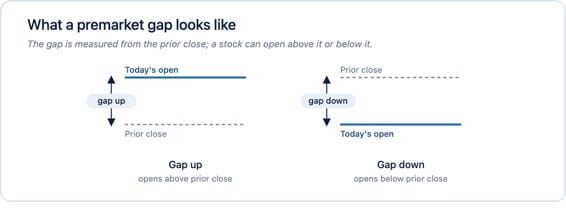
A gap is the distance between the prior close and where the stock opens; it can be up or down, and partial or full.
Reading the gap against the prior range
Traders look at where the gap sits relative to the prior day. A stock that gaps entirely above the prior day’s high has made a full gap up, which reflects a stronger catalyst than a small gap that stays inside the prior range. The gap size is descriptive, not predictive: a large gap is not a signal to trade in any direction.
How big are premarket gaps?
Premarket gaps range from fractions of a percent to high single digits or more, depending on the catalyst and the stock. The table below shows opening gaps from one recent session, to illustrate that range. It is a dated snapshot of market data, not a watchlist and not a recommendation.
| Stock | Prior close | Open | Opening gap |
| Strategy (MSTR) | 93.39 | 99.85 | +6.9% |
| Robinhood (HOOD) | 108.65 | 112.76 | +3.8% |
| Coinbase (COIN) | 159.24 | 165.19 | +3.7% |
| Palantir (PLTR) | 125.73 | 128.99 | +2.6% |
| Mara (MARA) | 13.37 | 13.63 | +1.9% |
| AMD (AMD) | 540.88 | 538.16 | -0.5% |
| IonQ (IONQ) | 51.40 | 51.11 | -0.6% |
Opening gaps from one recent session (regular-session open vs prior close). Source: Finnhub, early July 2026. Shown to illustrate the range of gap sizes; not a watchlist or a recommendation.
The spread of outcomes is the point: on the same morning, some names gap several percent while others barely move. The size of a gap reflects the strength of the catalyst and the stock’s volatility, and higher-volatility names, such as smaller or heavily traded speculative stocks, tend to gap more.
Why do some stocks gap more than others?
Some stocks gap more than others because of their float, their volatility, and how much of their trading is driven by news and retail participation. A given piece of news moves a low-float, high-volatility stock far more than it moves a large, widely held one.
Float and volume
Float is the number of shares available to trade. A stock with a small float has fewer shares absorbing buy and sell orders, so a catalyst moves its price more sharply, and a large gap on a low-float name can be both bigger and less stable. A large-cap stock with hundreds of millions of shares outstanding tends to gap in smaller percentages, because it takes far more volume to move it.
Volatility and beta
A stock’s typical volatility, sometimes measured by its beta relative to the market, shapes how it reacts to news. Higher-volatility names move more on the same catalyst, which is why speculative and news-driven stocks dominate the biggest premarket gaps while steadier names rarely appear. The broad market’s own volatility matters too; when the market is calm, a single-stock gap can still be large, but when the whole market is volatile, gaps cluster.
News concentration
Stocks that attract heavy retail attention and social-media flow tend to gap harder, because sentiment can move them quickly in thin premarket trading. That concentration cuts both ways: the same names that gap up sharply on good news gap down sharply on bad news. None of this makes any stock a buy or a sell; it explains why the size of a gap varies so widely from name to name.
Where do you find premarket movers?
Premarket movers are found with a scanner or a movers list that filters the market for the biggest gaps on volume before the open. Most active traders watch a scanner rather than a static list, so they can sort by gap percentage, premarket volume, float, and catalyst.
What a scanner filters on
A premarket scanner typically lets a trader filter by gap percentage, premarket volume, price, and float, so the list narrows to stocks with both a meaningful move and enough volume to trade. Filtering on volume is what separates a real mover from a thin-volume quote that will not hold.
Reading the catalyst behind the move
A number on a scanner is only half the picture; the catalyst behind it is the other half. Traders check the news to see whether a gap is driven by earnings, a rating change, an offering, or a rumor, because the type of catalyst shapes how the stock tends to behave. CMEG’s platforms include scanning and real-time data; you can compare the platforms to see the tools each one offers.
Why is premarket liquidity is generally thinner, and why does it matter?
Premarket liquidity tends to be thin because far fewer participants are trading than during regular hours, which widens bid-ask spreads and makes fills less predictable. A quoted premarket move can be exaggerated by that thinness, and it can reverse sharply when the deeper regular session opens.
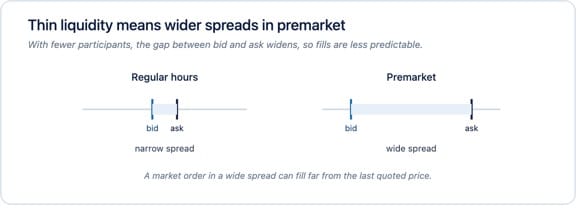
In thin premarket trading the bid-ask spread is wider than in regular hours, so fills are less predictable and quoted moves can be exaggerated.
Wider spreads, worse fills
In a thin market, the gap between the best bid and the best offer widens, so a market order can fill far from the last quoted price. This is why limit orders are the common tool in premarket, and why position sizing and risk controls matter more than usual when spreads are wide.
The move can be a mirage
Because a few orders can move a thin premarket quote, a large premarket percentage can shrink or reverse the moment regular-hours liquidity arrives at 9:30 a.m. ET. A mover that looks dramatic at 8:00 a.m. can look very different by 9:45 a.m.
Do premarket gaps continue or fill?
There is no reliable rule that a gap continues or fills; both happen, and neither is a strategy that makes money on its own. Traders use the terms gap-and-go for a stock that keeps moving in the gap direction and gap-fill for one that retraces toward the prior close, but these are observed behaviors, not predictions.
Behaviors, not rules
Whether a gap holds depends on the strength of the catalyst, the volume behind it, and how the broader market is trading that day. Treating gap-and-go or gap-fill as a certainty is how traders get caught on the wrong side of a fast move. A gap is a starting condition, not an outcome.
The role of the prior levels
Traders often watch the prior close, the prior day’s high and low, and premarket highs and lows as reference levels, because the market frequently reacts around them. Reading those levels is part of chart-reading rather than a guarantee; our beginner’s guide to reading stock charts covers the basics.
How does the 9:30 open interact with the gap?
The 9:30 a.m. ET open is when the deepest liquidity of the day arrives, and it often brings the highest volume and the fastest moves. A gap that was set in thin premarket trading gets its first real test when the regular session opens and the crowd arrives.
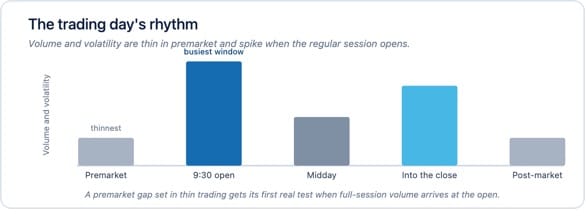
Volume and volatility are thin in premarket, spike at the 9:30 open, ease through midday, and pick up again into the close.
The opening auction
The regular session begins with an opening auction that sets the official opening print, after which continuous trading resumes. The first fifteen to thirty minutes are typically the most volatile of the day, as the premarket gap is repriced by full-session volume.
Why the open reprices the gap
Premarket prices are set by a small number of participants; the open brings in the institutions and the broad market. That is why a gap can hold, extend, or reverse in the opening minutes, and why the open is treated as a distinct, high-risk window rather than a continuation of premarket.
Halts and circuit breakers in premarket
Trading halts can interrupt a gapping stock, either because of pending news or because the price moved too far too fast. These mechanisms are designed to give the market time to absorb information, and they can freeze a position mid-move.
News-pending and volatility halts
A stock can be halted for pending news, which often precedes a large gap, and it can be halted under the limit-up-limit-down (LULD) rules when the price moves outside preset bands in a short window. A halt means a trader cannot enter or exit until it lifts, and the stock can reopen at a very different price.
Why halts add risk
A halt removes a trader’s control at the moment it may be needed most. Combined with a gap, a halt can mean a position reopens far from where it was frozen, which is one more reason premarket gap trading is high-risk.
What active traders watch on a gapping stock
Around a premarket mover, active traders generally watch the catalyst and its quality, the premarket volume, the gap relative to prior levels, and how the stock reacts at the open. These are factual watch-items, not signals to trade.
- The catalyst: what is driving the gap, and whether it is scheduled or a surprise.
- Premarket volume: whether the move has real participation behind it.
- The level: where the gap sits relative to the prior close, high, and low.
- The open: how the gap behaves when full-session liquidity arrives at 9:30 a.m. ET.
None of these is a recommendation. They describe what a stock is doing, not what it will do next.
What are the risks of trading premarket gaps?
The risks of premarket gap trading are concentrated and fast: thin liquidity, wide spreads, unpredictable fills, halts, and moves that reverse at the open. Add leverage and the exposure grows in both directions.
- Thin liquidity and wide spreads: fills can be far from the last price.
- Reversal risk: a premarket move can shrink or reverse when the regular session opens.
- Halts: a position can freeze mid-move and reopen at a very different price.
- Leverage: trading gaps on margin amplifies both gains and losses, and you can lose more than you deposit.
Trading premarket movers involves substantial risk, and most day traders lose money. Nothing here is a recommendation to trade any stock or any gap.
Frequently asked questions
What time is premarket trading?
Premarket trading runs from 4:00 a.m. to 9:30 a.m. ET, before the regular session, followed by a post-market session from 4:00 p.m. to 8:00 p.m. ET. Extended-hours sessions have thinner liquidity and wider spreads.
What causes a stock to gap in premarket?
Fresh information: earnings and guidance, analyst rating changes, mergers, regulatory decisions, macro data, or secondary offerings. Scheduled catalysts like earnings are on the calendar; unscheduled ones like downgrades produce surprise gaps.
Do premarket gaps always fill?
No. Some gaps continue in their direction and some retrace toward the prior close. Both are observed behaviors, not rules, and neither is a strategy that makes money on its own.
Why did a premarket mover reverse at the open?
Premarket prices are set by few participants in thin liquidity. When the regular session opens at 9:30 a.m. ET and full-market volume arrives, the gap is repriced and can shrink or reverse.
Can you trade premarket?
Yes, if your broker offers extended-hours access, but premarket trading carries added risk from lower liquidity and wider spreads. Not every broker offers it, and hours can vary.
Where do you find premarket movers?
With a premarket scanner or movers list that filters for the biggest gaps on volume before the open. Reading the catalyst behind a mover matters as much as the percentage on the list.
References
[1] Finnhub, stock quotes (regular-session open and prior close), retrieved July 3, 2026. https://finnhub.io
[2] Capital Markets Elite Group, FAQs (trading session hours and extended-hours risk). https://www.cmelitegroup.com/faqs/
[3] Finnhub, company earnings calendar (scheduled earnings dates), retrieved July 3, 2026. https://finnhub.io
[4] U.S. Bureau of Labor Statistics, Consumer Price Index release schedule (next release July 14, 2026, 8:30 a.m. ET). https://www.bls.gov/schedule/news_release/cpi.htm
[5] U.S. Securities and Exchange Commission, on the Limit Up-Limit Down (LULD) mechanism and trading halts. https://www.sec.gov
[6] Federal Reserve Bank of St. Louis (FRED), Cboe Volatility Index: VIX (VIXCLS), value for July 1, 2026. https://fred.stlouisfed.org/series/VIXCLS
Disclosures: Trading involves substantial risk and is not suitable for every investor. Capital is at risk and most day traders lose money. Extended-hours trading, including premarket, carries additional risk from lower liquidity and wider spreads. Leverage amplifies both gains and losses, and you can lose more than you deposit. Client accounts are not SIPC or FSCS insured. This content is provided for information and education only. It is not investment advice or a recommendation of any security, strategy, or account type. The stocks named in the opening-gaps table are shown only to illustrate the range of gap sizes and are not recommendations. Market data is sourced from Finnhub and FRED and session hours from CMEG and the exchanges, as dated above. See our full disclosures and policies.